Session 7: The midterms of 3 November 2026: what is at stake?
Recap check
How many members does the House have?
How long is a senator's term?
Which part of the Senate is elected every two years?
Answer key
435 voting members.
Six years.
One third.
Question: Why are the midterms important, even without a presidential election?
Objectives
Explain what a midterm election is
Read the balance of power in Congress before the vote
Say what can change after the vote
What we need to say
In this session, you need to say what can really happen on 3 November, and imagine different rules.
To talk about what is at stake, we need these words: midterms, seat, majority, governor, special election, redraw a map.
To say what can really happen, we need the first conditional; to imagine other rules, we need the second conditional: If the Democrats win 218 seats, they will control the House. If there were no midterms, the House would stay the same for four years.
Words to say it
Word
Meaning
Example
the midterms
the elections in the middle of a president's term
The midterms are on 3 November 2026.
a seat
a place in a chamber
Democrats have 214 seats.
a majority
more than half of the seats
218 seats make a majority in the House.
a governor
the head of a state
Thirty-six states elect a governor.
a special election
an election to replace someone who left
Ohio has a special election.
to redraw a map
to change the borders of districts
Texas redrew its map in 2025.
Use the words: word partners
Word partners. Match the verbs with the nouns to make phrases from the session: win, hold, elect, redraw, break.
______ a majority
______ a special election
______ a governor
______ a district map
______ a tie
Answer key
win a majority
hold a special election
elect a governor
redraw a district map
break a tie
Word partners (ten)Entry
To talk about what is at stake, match the verb with the right noun.
win
hold
elect
redraw
break
cast
lose
gain
flip
count
a. a seat
b. a ballot
c. a state
d. a district map
e. the votes
f. a majority
g. seats
h. a governor
i. a tie
j. a special election
Answer key
f (a majority)
j (a special election)
h (a governor)
d (a district map)
i (a tie)
b (a ballot)
a (a seat)
g (seats)
c (a state)
e (the votes)
Definitions (ten)Core
Write the word: midterms, seat, governor, special election, ballot measure, turnout, gerrymandering, majority, incumbent, to concede.
the elections in the middle of a president's term
a place in a chamber
the head of a state
an election to replace someone who left
a local question put directly to the voters
the share of citizens who vote
drawing districts to help one party
more than half of the seats
the person who already has the job
to accept defeat
Answer key
the midterms
a seat
a governor
a special election
a ballot measure
turnout
gerrymandering
a majority
the incumbent
to concede
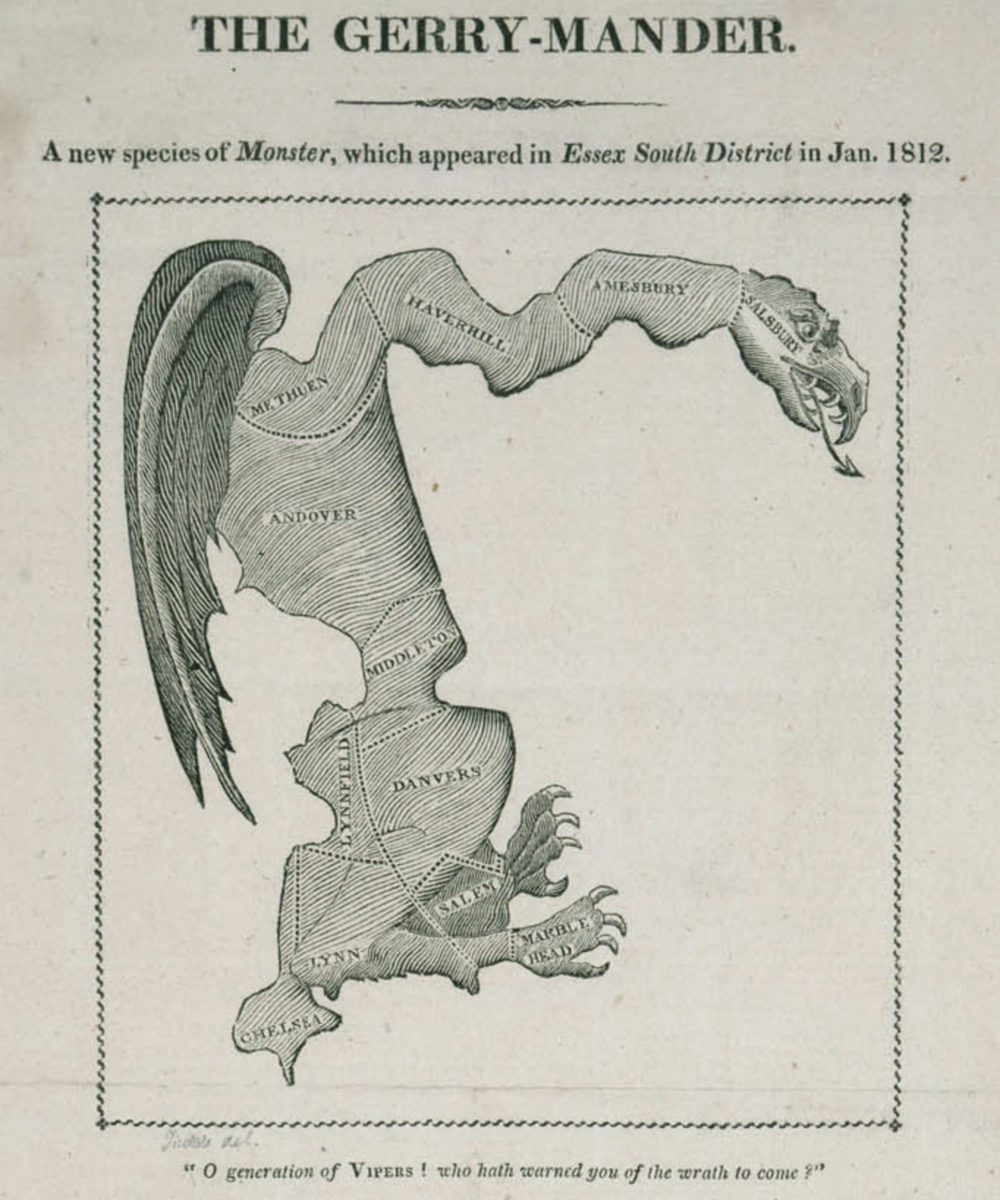
Attributed to Elkanah Tisdale, The Gerry-Mander. A New Species of Monster which Appeared in Essex South District in Jan. 1812, 1812, printed broadside. Massachusetts Historical Society, Boston. Public domain. Record
Picture labelling: The Gerry-Mander (1812)Core
Look at the broadside. Find:
the title
the date
the head and the beak
the wings
the claws
names of towns inside the map
Answer key
at the top: The Gerry-Mander
in the subtitle: January 1812
at the top right
on the left
at the bottom
for example Haverhill, Andover, Danvers, Lynn, Chelsea: written inside the shape
Odd one outCore
Find the word that does not belong and say why.
House, Senate, governor, Congress
seat, chair, majority, bench
Florida, Ohio, Texas, Washington, D.C.
to win, to gain, to flip, to lose
midterms, primaries, Election Day, Inauguration Day
map, district, border, ballot
Answer key
governor: the others are about Congress.
majority: the others are places to sit (seat is also a place in a chamber).
Washington, D.C.: it is not a state.
to lose: the others mean to get something.
Inauguration Day: the others are votes.
ballot: the others are about the shape of districts.
Documents
Key document
Midterm elections take place halfway through a president's four-year term. On Tuesday 3 November 2026, Americans elect all 435 members of the House and 35 senators: 33 in regular elections, plus two special elections in Florida and Ohio to replace Marco Rubio, now Secretary of State, and JD Vance, now Vice President. Thirty-six states also elect a governor, and voters decide on ballot measures, local questions put to the voters. Before the vote, the Republicans control both chambers: in the House, 218 Republicans, 214 Democrats, one independent and two empty seats (official list of the Clerk, 1 October 2026); in the Senate, 53 Republicans and 47 Democrats and independents who vote with them. A party needs 218 seats for a majority in the House and 51 in the Senate; with 50 seats each, the Vice President breaks the tie. The new Congress meets on 3 January 2027. If the opposition wins a chamber, it can block bills and open investigations. In 2025 and 2026, several states redrew their district maps before the vote, for example Texas in 2025 and California, where voters approved Proposition 50 in November 2025.
Plus one independent and two empty seats. Source: Clerk of the House, official list, 1 October 2026.
Senate (100 seats, majority: 51)
Rep. 53Dem. and allies 47
51
On the ballot on 3 November 2026
What?
How many?
Why it matters
House of Representatives
all 435 seats
the majority votes the laws and the budget, and can investigate the government
Senate
35 seats: 33 regular, 2 special (Florida, Ohio)
the majority confirms judges and ministers
Governors
36 states
they lead their state
Ballot measures
questions put directly to voters in many states
local laws on taxes, voting rules, health
Look at the drawings
Attributed to Elkanah Tisdale, The Gerry-Mander. A New Species of Monster which Appeared in Essex South District in Jan. 1812, 1812, printed broadside. Massachusetts Historical Society, Boston. Public domain. Record
Activities
Read the seat bars: how many seats do the Democrats need to reach 218 in the House? And 51 in the Senate?
List three things that voters choose on 3 November 2026.
Say it: with the seat bars, say what will happen if each party wins (first conditional), then imagine one different rule (second conditional).
Look at the 1812 cartoon: a district map became a monster. Why do people criticise strange district shapes?
After the vote: you will find the results yourself on reliable websites, in session 9.
Grammar to say it: the conditional (3), real or imaginary?
Why we need it
To say what can really happen, we need the first conditional; to imagine other rules, we need the second conditional: If the Democrats win 218 seats, they will control the House. If there were no midterms, the House would stay the same for four years.
Grammar point: board explanation
Teacher script
Show the seat bars. Ask two questions: What will happen if the Democrats win 218 seats? What would happen if there were no midterms?
Write both answers side by side and compare the verbs.
Explain how to choose: can it really happen on 3 November? first conditional. Is it a dream or another rule? second conditional.
Prepare the results lesson: past simple with a finished date (The House was won on 3 November) and present perfect for news linked to now (The results have just been announced).
Write the time markers: yesterday, on 3 November (past simple); just, already, yet, since, for (present perfect).
Students copy, then do the quick check.
Board: students copy
Real or imaginary? Both conditionals; present perfect and past simple
Rule
Real: If + present, will. Imaginary: If + past, would.
Form
If the Democrats win 218 seats, they will control the House. If there were no midterms, the House would stay the same for four years.
Use
Real: what can happen on 3 November. Imaginary: other rules, dreams, debates.
Examples from the lesson
If the Senate is split 50 to 50, the Vice President will break the tie.
If every state used the same map rules, gerrymandering would be harder.
The results have just been announced. The House was won on 3 November.
Common mistakes
If the Democrats would win → If the Democrats win.
The results have been announced on 3 November. → The results were announced on 3 November (finished date).
Since two years → for two years; since 2024.
French and English
French depuis → for + duration (for two years) or since + starting point (since 2024), with the present perfect: Republicans have controlled the House since 2023.
Also on the board: Tenses: present perfect or past simple?
Past simple + finished time: yesterday, on 3 November, in 2022. Present perfect + link to now: just, already, yet, since, for: The results have not been announced yet.
Quick check, with the whole class
Real or imaginary? If a party wins 51 seats, it will have a majority.
If there ______ (be) no Senate, the House ______ (make) the laws alone.
The results ______ just ______ (announce).
______ 2024 / ______ two years
Correct: The House has been won on 3 November.
Answer key
real
were, would make
have, been announced
since, for
The House was won on 3 November.
Grammar to say it: four stages
Stage 1. RecogniseEntry
Real (R, first conditional) or imaginary (I, second conditional)?
If the Republicans keep 218 seats, they will control the House.
If all Americans voted, turnout would be one hundred per cent.
If a party wins 51 seats in the Senate, it will have a majority.
If there were no midterms, the House would stay the same for four years.
If the Democrats win the House, they will open investigations.
If senators were all elected on the same day, the whole Senate could change at once.
If the Senate is split 50 to 50, the Vice President will break the tie.
If every state used the same map rules, gerrymandering would be harder.
If counting is slow, the results will come later.
If I were American, I would vote on 3 November.
Answer key
R
I
R
I
R
I
R
I
R
I
Stage 2. TransformCore
Put the verbs in the right form. Decide: real or imaginary?
If the Democrats ______ (win) the House, they ______ (open) investigations.
If the Senate ______ (be) split 50 to 50, the Vice President ______ (break) the tie.
If senators ______ (be) elected for two years, they ______ (campaign) all the time.
If turnout ______ (be) high, the result ______ (be) clearer.
If there ______ (be) no Senate, the House ______ (make) the laws alone.
If the Republicans ______ (keep) both chambers, the president ______ (have) more power.
If Texas ______ (not redraw) its map, the result ______ (be) different.
If you ______ (be) eighteen and American, you ______ (can) vote.
Answer key
win, will open
is, will break
were, would campaign
is, will be
were, would make
keep, will have
had not redrawn, would have been (stretch: third conditional) or did not redraw, would be
were, could
Stage 3. Guided productionCore
Answer with the right conditional. Look at the seat bars.
What will happen if the Democrats win 218 House seats?
What will happen if the Republicans keep 51 Senate seats?
What will happen if the Senate is split 50 to 50?
What will happen if the opposition wins the House?
What would happen if there were no midterms?
What would happen if all citizens voted?
What would happen if district maps were drawn by independent commissions everywhere?
What would you do if you could vote on 3 November?
Answer key
If they win 218 seats, they will control the House.
If they keep 51 seats, they will keep the majority.
The Vice President will break the tie.
It will be able to block bills and open investigations.
The House would stay the same for four years.
Turnout would be one hundred per cent.
Gerrymandering would be harder.
Your own answer: If I could vote, I would ...
Stage 4. Your turnStretch
Before the results: write a short radio script (six sentences) with two real and two imaginary conditionals.
Radio script
Answer key
Model: Good morning, today Americans vote in the midterms. All 435 House seats are at stake. If the Democrats win 218 seats, they will control the House. If the Republicans keep their majority, they will support the president. If there were no midterms, nothing would change for four years. If every young American voted, the result would be very different.
Extra practice
C. Now say it: real and imaginaryStretch
Write one real and one imaginary sentence about the midterms.
Real: the House on 3 November
Answer key
Example: If the Republicans keep their majority, they will still control the House. If there were no Senate, the House would make the laws alone.
Figures of speech: the blend word and political metaphors
Learn
Gerrymander is a blend word: Governor Gerry + salamander, because a district looked like a salamander and Elkanah Tisdale added a head, wings and claws. Commentators also use metaphors: the midterms are a referendum on the president; a close race is a toss-up (like a coin); a president who has lost power is a lame duck.
Which two words make gerrymander?
Why did the artist draw a monster?
Why are the midterms called a referendum on the president?
Where does toss-up come from?
What is a lame duck?
Invent a blend word for a school situation and explain it.
Answer key
Gerry and salamander.
To show that the district was unnatural and dangerous for democracy.
Many voters use them to judge the president's first two years.
From tossing a coin: heads or tails, nobody knows.
An official who stays in office until a successor takes over, with less power.
Core First write, then speak. Use the words and the grammar of the session.
Written task: an explainer for French readers (about 100 words)
Steps
Title: The midterms in five questions.
What, when, who is elected.
The balance before the vote.
What can change (first conditional).
One imaginary idea (second conditional).
Sentence starters
The midterms are ...
On 3 November 2026, Americans elect ...
Before the vote, ...
If the Democrats win ..., they will ...
If there were no midterms, ...
Model answer
The midterms in five questions. The midterms are the elections in the middle of the president's term. On 3 November 2026, Americans elect all 435 representatives, 35 senators and 36 governors. Before the vote, the Republicans control both chambers. If the Democrats win 218 seats, they will control the House. If there were no midterms, voters could not judge the president for four years.
Oral task: a one-minute podcast, what is at stake?
Steps
Introduce the podcast.
Give three numbers.
Say what can change.
Ask listeners to follow the results.
Sentence starters
Welcome to ...
Today, ...
The key numbers are ...
If ..., ...
Stay tuned for the results.
Model answer
Welcome to Election Talk. Today, Americans vote in the midterms. The key numbers are 435, 35 and 36. If the opposition wins the House, the president will find it harder to pass laws. Stay tuned for the results.
Going further (B2 towards C1)
For students aiming at language studies
The language of the results (B2)Going further
Match each phrase with its meaning.
to call a race
to retain control
a net gain
a divided government
to unseat an incumbent
a mandate
a. the seats won minus the seats lost
b. the president's party does not control both chambers
c. to keep the majority
d. to announce the winner after enough votes are counted
e. the authority given by the voters
f. to beat the person who had the seat
Answer key
d (to announce the winner after enough votes are counted)
c (to keep the majority)
a (the seats won minus the seats lost)
b (the president's party does not control both chambers)
f (to beat the person who had the seat)
e (the authority given by the voters)
Finer grammar: present perfect and past simple for results; the passive of reportingGoing further
Rule
Past simple with a finished time: The House was won on 3 November. Present perfect with a link to now: The results have just been announced. Reporting passive: The Senate is expected to remain close. It is thought that turnout will be high.
The polls / close / at nine p.m. yesterday.
The results / just / announce.
People expect that the Senate will remain close. (The Senate is expected ...)
People think that turnout will be high. (It is thought ...)
Answer key
The polls closed at nine p.m. yesterday.
The results have just been announced.
The Senate is expected to remain close.
It is thought that turnout will be high.
Translation, French to EnglishGoing further
Si les démocrates gagnent 218 sièges, ils contrôleront la Chambre.
Les résultats n'ont pas encore été annoncés.
On s'attend à ce que le Sénat reste serré.
Si les cartes n'avaient pas été redessinées, le résultat aurait peut-être été différent.
Answer key
If the Democrats win 218 seats, they will control the House.
The results have not been announced yet.
The Senate is expected to remain close.
If the maps had not been redrawn, the result might have been different.
Text analysis: a pattern in midterm historyGoing further
Midterm elections have often been difficult for the party in the White House. In 2010, two years after Barack Obama's victory, Republicans won control of the House. In 2018, under Donald Trump's first presidency, Democrats took it back. In 2022, during Joe Biden's term, Republicans regained the House. Political scientists suggest several reasons: voters who are unhappy are more likely to turn out, and the president's supporters may feel less urgency once their candidate is in office.
Find the three examples and say who won the House each time.
Which tense is used in the first sentence, and why?
Find a word meaning took back.
Give the two reasons suggested.
Is this pattern a rule? Justify with a word from the text.
Unhappy voters vote more; the president's supporters feel less urgency.
No: often and suggest show a tendency, not a rule.
Argued task (200 to 250 words, or a two-minute oral)Going further
Are the midterms a referendum on the president? Use the history of 2010, 2018 and 2022, then wait for the results of 2026 to check your argument.
Steps
Define the midterms.
Examples from history.
Other factors (local candidates, district maps, turnout).
Your conclusion, to update with the 2026 results.
Sentence starters
The midterms are widely seen as ...
History suggests that ...
However, other factors such as ... also matter.
If the results confirm ..., ...
To conclude, ...
Key points
Key points: midterms halfway through the term; 2010, 2018, 2022 show the president's party losing the House; other factors: candidates, redistricting (Texas, California), turnout, the economy; a conclusion that stays open until the official 2026 results are checked.
Exercise
Calculate: 1. In the House, the Democrats have 214 seats. How many more do they need to reach 218? 2. In the Senate, the Democrats and their independent allies have 47 seats. How many more do they need to reach 51?
Answer key1. 218 − 214 = 4 more seats. 2. 51 − 47 = 4 more seats.
At work, a team leader needs the support of the team to change the rules. Compare with a president who loses his majority in Congress.
Levels
Level
Adjustment
Entry (guided B1)
Read the bars and answer three questions with numbers.
Core (B1)
Explain what is at stake in five sentences.
Stretch (B1+)
Explain the gerrymander cartoon and the link with the new maps of 2025 and 2026.
Oral
Present what is at stake on 3 November 2026 in one minute.
Homework
Choose one race of 3 November 2026 to follow: a Senate seat or a governor. Write three sentences: which state, which office, why it matters. You will look for its result yourself in session 9.
Answer keyModel answer: I follow the Senate race in Ohio. It is a special election to replace JD Vance, who is now Vice President. It matters because every seat counts for the majority of 51 in the Senate. (Any race of 2026 is accepted.)