Question: Who makes the laws, and how are they elected?
Objectives
Compare the House of Representatives and the Senate
Understand why the Senate is elected by thirds
Use numbers and durations: every two years, for six years
What we need to say
In this session, you need to imagine how things would change if the rules or the numbers were different.
To explain how a law is made, we need these words: Congress, representative, senator, district, bill, veto.
To imagine a result, we need the second conditional: If she won Texas, she would get forty electoral votes. What would happen if the president vetoed a bill?
Words to say it
Word
Meaning
Example
Congress
the House and the Senate together
Congress makes the laws.
a representative
a member of the House
A representative is elected for two years.
a senator
a member of the Senate
Each state has two senators.
a district
a part of a state that elects one representative
Wyoming has one district.
a bill
a proposed law
Both chambers must pass a bill.
a veto
when the president refuses to sign a bill
The president can use a veto.
Find the word (ten)Entry
To explain how a law is made, find the word. The first letter is given.
The House and the Senate together: C _ _ _ _ _ _ _
A member of the House: r _ _ _ _ _ _ _ _ _ _ _ _ _
A proposed law: b _ _ _
When the president refuses to sign: v _ _ _
A part of a state that elects one representative: d _ _ _ _ _ _ _
A member of the Senate: s _ _ _ _ _ _
One of the two parts of Congress: c _ _ _ _ _ _
The leader of the House: the S _ _ _ _ _ _
To accuse a president officially: to i _ _ _ _ _ _
To pass a bill after a veto: to o _ _ _ _ _ _ _ the veto
Answer key
Congress
representative
bill
veto
district
senator
chamber
Speaker
impeach
override
House or Senate? (ten facts)Core
Write H (House) or S (Senate).
435 voting members
100 members
a two-year term
a six-year term
minimum age: twenty-five
minimum age: thirty
seats by population
two members per state
impeaches a president
holds the trial and confirms judges
Answer key
H
S
H
S
H
S
H
S
H
S
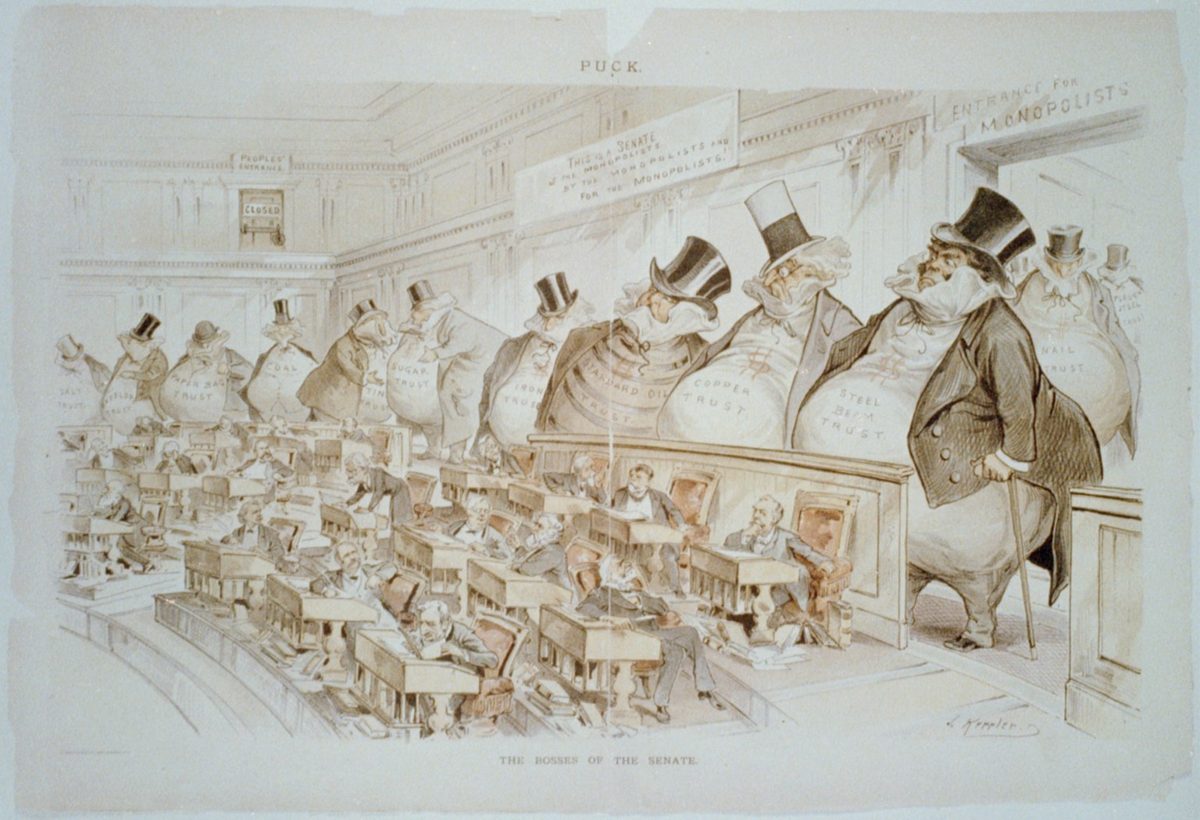
Joseph Keppler, The Bosses of the Senate, 1889, colour lithograph, Puck, 23 January 1889. Library of Congress, Prints and Photographs Division. Public domain. Record
Picture labelling: The Bosses of the Senate (1889)Core
Look at Keppler's cartoon. Find:
the People's Entrance
the Entrance for Monopolists
the sign on the wall
the giant money bags
three names on the bags
the senators
Answer key
at the top left: it is closed
at the top right: it is open
This is a Senate of the monopolists, by the monopolists and for the monopolists!
standing behind the senators, with top hats
for example Sugar Trust, Standard Oil Trust, Copper Trust, Steel Beam Trust, Nail Trust
small men at their desks, in the front
Word familiesCore
Complete.
to legislate: ______ (the laws), a legislator, ______ (adjective)
to represent: a ______
to impeach: ______ (the noun)
to confirm: a ______
to govern: the ______, a governor
to vote: a ______ (person), a ______ (the act)
Answer key
legislation, legislative
representative
impeachment
confirmation
government
voter, vote
Documents
Key document
Congress has two chambers. The House of Representatives has 435 voting members: each represents a district, and big states have more districts. Representatives are elected for two years, so all 435 seats are elected every two years. A representative must be at least twenty-five. The Senate has 100 senators, two per state, whatever the size of the state. Senators are elected for six years, and every two years one third of the Senate is elected. A senator must be at least thirty. A bill must be passed by both chambers; then the president signs it or refuses it with a veto. Only the House can impeach a president; the Senate holds the trial and confirms judges and ministers. The Speaker of the House is Mike Johnson; the Vice President, JD Vance, presides over the Senate and can break a tie.
by population: from 1 (for example Wyoming) to 52 (California)
2 for every state
Term
2 years
6 years
Elected
all seats every two years
one third every two years
Minimum age
25
30
Special powers
impeaches a president; starts tax laws
holds the trial; confirms judges and ministers; approves treaties
Leader in 2026
the Speaker, Mike Johnson
the Vice President, JD Vance, presides
The Senate by thirds
Group of senators
Last elected
Next election
Group 1
2024
2030
Group 2
2020
3 November 2026
Group 3
2022
2028
How a bill becomes a law
1the House votes yes
2the Senate votes yes
3the President signs, or uses a veto
4after a veto, two thirds of each chamber can still pass it
Sources: house.gov, USAGov, the Constitution.
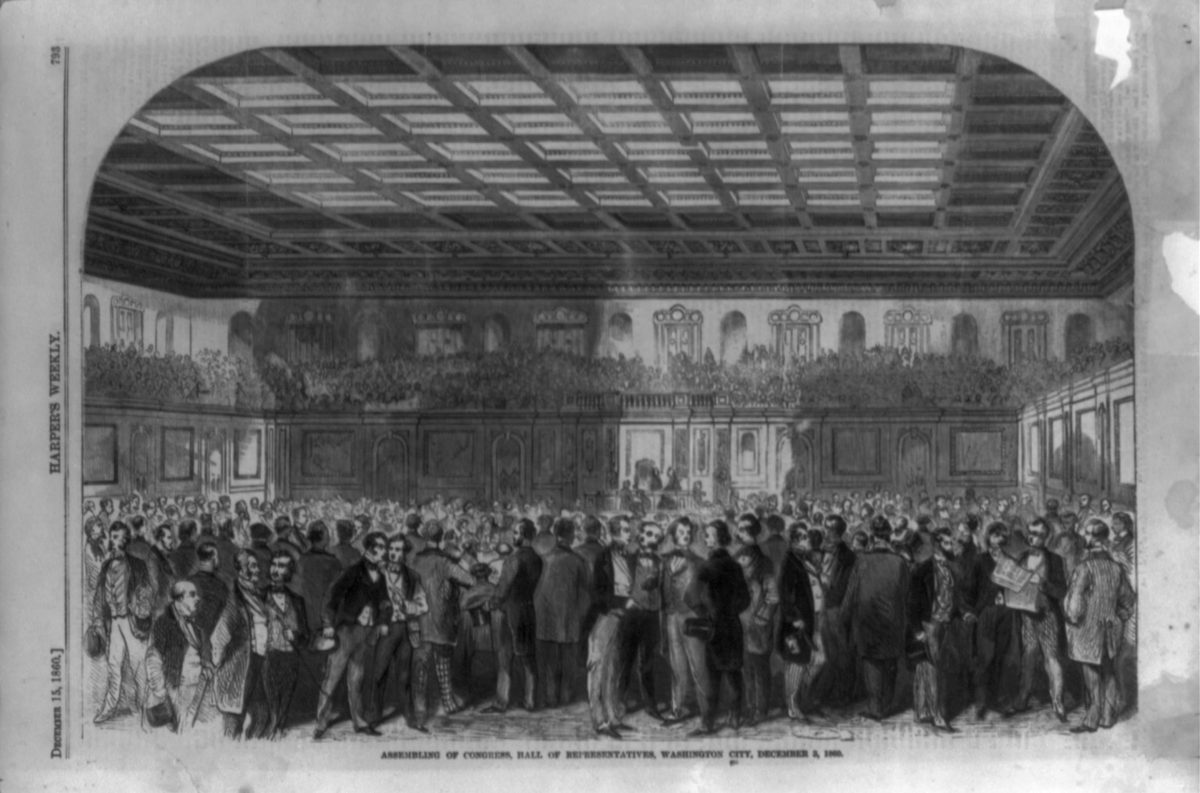
Look at the drawings
Unknown artist, Assembling of Congress, Hall of Representatives, Washington City, December 3, 1860, wood engraving, Harper's Weekly, 15 December 1860. Library of Congress, Prints and Photographs Division. Public domain. RecordJoseph Keppler, The Bosses of the Senate, 1889, colour lithograph, Puck, 23 January 1889. Library of Congress, Prints and Photographs Division. Public domain. Record
Activities
Complete the comparison table: members, term, minimum age, who they represent.
Read the thirds diagram: which senators are elected in 2026? And in 2028?
Say it: imagine. What would happen if the president vetoed a bill? If Wyoming had more people? Answer with If + past, would + verb.
Look at the 1889 cartoon: who are the giants behind the senators? At that time, senators were chosen by state parliaments, not by the people; the 17th Amendment changed this early in the twentieth century.
Summary: the House follows the population, the Senate gives two seats to each state.
Grammar to say it: the conditional (2), imaginary situations
Why we need it
To imagine a result, we need the second conditional: If she won Texas, she would get forty electoral votes. What would happen if the president vetoed a bill?
Grammar point: board explanation
Teacher script
Ask: What would happen if a candidate won Texas? Write: If she won Texas, she would get forty electoral votes.
Explain: the past form does not mean the past here; it means imaginary or unlikely.
Contrast on the board with the first conditional (session five): real versus imaginary.
Teach If I were: were for all persons in careful English.
Explain the position of adverbs of frequency: before the main verb, after be: Senators are rarely young; the House usually votes first.
Students copy, then do the quick check.
Board: students copy
The second conditional; adverbs of frequency
Rule
Imaginary or unlikely situation: If + past simple, would + verb.
Form
If a candidate won Texas, she would get forty electoral votes.If I were a senator, I would vote yes. Question: What would happen if the president vetoed a bill?
Use
To imagine, to give advice, to discuss other rules.
Examples from the lesson
If Wyoming had more people, it would have more representatives.
If I were in Congress, I would vote for this bill.
What would happen if the House and the Senate disagreed?
Common mistakes
If I would be a senator → If I were a senator.
If she wins Texas, she would get → If she won Texas, she would get (keep the pair).
He votes always → He always votes.
French and English
French: Si j'étais sénateur, je voterais oui. Same logic: si + imparfait = if + past; conditionnel = would. Never si je serais, never if I would be.
Also on the board: Word order: adverbs of frequency
always, usually, often, sometimes, rarely, never: before the main verb (The House usually votes first), after be (Independents are rarely elected).
Quick check, with the whole class
If she ______ (win) Texas, she ______ (get) forty votes.
If I ______ (be) a senator, ...
Real or imaginary? If Congress had one chamber, laws would pass faster.
Put in order: votes / the House / first / usually
Correct: If I would be president, I would ...
Answer key
won, would get
were
imaginary
The House usually votes first.
If I were president, I would ...
Grammar to say it: four stages
Stage 1. RecogniseEntry
Real possibility (1) or imaginary situation (2)?
If the president vetoes the bill, Congress will vote again.
If I were a senator, I would vote yes.
If the House passes the bill, the Senate will vote next week.
If Wyoming had more people, it would have more representatives.
If a candidate won Texas, she would get forty electoral votes.
If the bill passes, the president will sign it.
If Congress had only one chamber, laws would pass faster.
If senators were elected for two years, they would campaign all the time.
Answer key
1
2
1
2
2
1
2
2
Stage 2. TransformCore
Imagine the opposite of the fact (second conditional).
Senators are elected for six years. (two years)
Each state has two senators. (by population)
The president can veto a bill. (could not)
Congress has two chambers. (one)
Texas has forty electoral votes. (a candidate wins it)
Senators are elected by the people. (state parliaments)
The Vice President breaks ties. (no Vice President)
I am not a senator.
France has no Electoral College.
Wyoming has one representative. (more people)
Answer key
If senators were elected for two years, they would campaign all the time.
If senators were given by population, California would have many more senators.
If the president could not veto a bill, Congress would be more powerful.
If Congress had only one chamber, laws would pass faster.
If a candidate won Texas, she would get forty electoral votes.
If senators were still chosen by state parliaments, voters would have less power.
If there were no Vice President, a tied vote would fail.
If I were a senator, I would vote for ... (your idea).
If France had an Electoral College, the president would be chosen by electors.
If Wyoming had more people, it would have more representatives.
Stage 3. Guided productionCore
What would happen if ...? Answer in a full sentence.
... the House and the Senate disagreed on a bill?
... the president vetoed a bill?
... a state had only one representative?
... the Senate were split 50 to 50 on a vote?
... the House impeached a president?
... two thirds of the senators voted guilty?
... a senator resigned?
... you were a representative for one day?
Answer key
If they disagreed, the bill would not become a law.
If the president vetoed it, Congress would need two thirds of each chamber to pass it.
It would have three electors (one plus two senators).
The Vice President would break the tie.
The Senate would hold a trial.
The president would be removed from office.
A replacement would be chosen, then a special election would be held, as in Florida and Ohio in 2026.
Your own answer: If I were a representative, I would ...
Stage 4. Your turnStretch
Imagine a new rule for Congress. Write six sentences with the second conditional, then debate in groups.
Six sentences
Answer key
Model: If representatives were elected for four years, they would have more time to work. They would campaign less. But voters would have fewer chances to change them. If young people could be elected at eighteen, the House would look younger. It would talk more about schools and jobs. I would vote for this rule.
Extra practice
A. Choose the right formEntry
Choose the correct verb.
If I (was / were) a representative, I (will / would) visit my district every week.
If California (had / has) fewer people, it (would have / will have) fewer seats.
If the president (vetoed / vetoes) the bill, Congress (would vote / votes) again.
Answer key
were, would
had, would have
vetoed, would vote
B. Complete with the second conditionalCore
Put the verbs in the right form.
If a candidate ______ (win) Texas, she ______ (get) forty electoral votes.
If Wyoming ______ (have) more people, it ______ (get) more representatives.
If I ______ (be) a senator, I ______ (vote) for ______ (your idea).
Answer key
won, would get
had, would get
were, would vote (any idea)
C. Now say it: what would happen if...?Stretch
Answer each question with a full second conditional sentence.
What would happen if the House and the Senate disagreed on a bill?
What would happen if the president vetoed a bill?
What would happen if a state had only one representative?
Answer key
If they disagreed, the bill would not become a law.
If the president vetoed it, Congress would need two thirds of each chamber to pass it.
If a state had only one representative, it would have three electors (one plus two senators).
Figures of speech: parody, hyperbole and personification
Learn
A parody copies famous words to make fun of something. Keppler's sign parodies Lincoln's Gettysburg Address (1863): government of the people, by the people, for the people. Hyperbole is exaggeration: the money bags are huge. Personification: the bags have faces and hats, like people.
Which famous words does the sign parody?
Why are the money bags drawn so big?
Why is the People's Entrance closed?
Which figure of speech gives the bags faces?
Capitol Hill passed a bill. What is this figure (seen in session four)?
Write your own parody: a school of the ______, by the ______, for the ______.
Answer key
Lincoln's Gettysburg Address: government of the people, by the people, for the people.
Hyperbole: to show that big companies were too powerful.
It is a symbol: ordinary people had no access to the Senate.
Personification.
Metonymy (Capitol Hill = Congress).
Example: a school of the students, by the students, for the students.
Expression task: write it, say it
Core First write, then speak. Use the words and the grammar of the session.
Written task: a letter to a representative (about 100 words)
Steps
Greeting and who you are.
The problem in your town.
What you would do if you were in Congress.
Your request.
Polite ending.
Sentence starters
Dear Representative,
I am a student in ... and I am writing to ...
In our town, ...
If I were in Congress, I would ...
If this bill were passed, ...
Yours sincerely,
Model answer
Dear Representative, I am a student in a vocational school and I am writing to ask for more apprenticeships. In our town, many young people cannot find a company. If I were in Congress, I would vote for help for small companies that train young people. If this bill were passed, more students would find a job. Yours sincerely, Lina.
Oral task: mini debate, should every state have two senators?
Steps
Choose a side.
Give two arguments.
Answer the other side.
Vote.
Sentence starters
I agree / disagree because ...
If every state had the same number of senators as its population, ...
That's true, but ...
If small states lost their senators, ...
Model answer
I agree with two senators per state because small states need a voice. If senators were given by population, Wyoming would almost disappear. That's true, but California has many more people, so it is not fair for them.
Going further (B2 towards C1)
For students aiming at language studies
Legislative jargon (B2)Going further
Match each phrase with its meaning.
to filibuster
a bipartisan bill
gridlock
checks and balances
to pass a bill into law
a lobbyist
a. a bill supported by both parties
b. to speak for a very long time to block a vote in the Senate
c. a person paid to influence lawmakers
d. to adopt it so that it becomes law
e. a situation where nothing can be passed
f. the way each branch limits the others
Answer key
b (to speak for a very long time to block a vote in the Senate)
a (a bill supported by both parties)
e (a situation where nothing can be passed)
f (the way each branch limits the others)
d (to adopt it so that it becomes law)
c (a person paid to influence lawmakers)
Finer grammar: mixed conditionals and inversionGoing further
Rule
Mixed conditional: past condition, present result: If the 17th Amendment had not been ratified, senators would still be chosen by state legislatures today. Formal inversion: Were the president to veto the bill, Congress would vote again.Should the Senate be split, the Vice President would vote.
Rewrite with inversion: If the president vetoed the bill, Congress would vote again.
Rewrite with inversion: If the Senate is split 50 to 50, the Vice President will break the tie. (Should ...)
Mixed: The Constitution created two chambers in 1787. Congress has two chambers today. (If ... had not ..., ... would not ...)
Mixed: The 17th Amendment was ratified. Voters elect their senators today.
Answer key
Were the president to veto the bill, Congress would vote again.
Should the Senate be split 50 to 50, the Vice President will break the tie.
If the Constitution had not created two chambers in 1787, Congress would not have two chambers today.
If the 17th Amendment had not been ratified, voters would not elect their senators today.
Translation, French to EnglishGoing further
Si j'étais sénateur, je voterais pour cette loi.
Si le président opposait son veto, le Congrès devrait voter à nouveau.
Si le Wyoming avait plus d'habitants, il aurait plus de représentants.
Que se passerait-il si le Sénat était divisé en deux ?
Answer key
If I were a senator, I would vote for this bill.
If the president vetoed it, Congress would have to vote again.
If Wyoming had more inhabitants, it would have more representatives.
What would happen if the Senate were split in two (evenly divided)?
Text analysis: the Senate and the money bagsGoing further
When Joseph Keppler drew The Bosses of the Senate in 1889, senators were not elected by the people but chosen by state legislatures. Critics claimed that rich companies, the trusts, could buy influence in these assemblies. Reformers campaigned for years, and in the early twentieth century the 17th Amendment gave the choice of senators to the voters. Were Keppler alive today, he might draw new money bags: the debate about money in politics has never really ended.
Find the conditional with inversion and rewrite it with if.
Who chose the senators in 1889?
What were the trusts?
Find a reporting verb.
Is the last sentence a fact or an opinion? Explain.
Answer key
Were Keppler alive today, he might draw ... = If Keppler were alive today, he might draw ...
State legislatures (state parliaments).
Very large companies that controlled whole industries.
claimed.
An opinion: might and has never really ended show the author's view.
Argued task (200 to 250 words, or a two-minute oral)Going further
Is the American Congress more democratic than the French Parliament? Compare how members are elected and what powers they have.
Steps
Introduction: two chambers in both countries.
Elections compared (direct vote for both American chambers; the French Senate is elected indirectly).
Powers compared.
Your argued conclusion.
Sentence starters
Both countries have ...
Whereas American senators are elected directly, ...
Were France to elect its senators directly, ...
It could be argued that ...
In conclusion, ...
Key points
Key points: two chambers in both countries; in the USA both are elected by the people; in France, deputies are elected directly and senators by local elected officials; the American Congress has strong powers (budget, impeachment, confirmation); a nuanced conclusion. Use one inversion and one mixed conditional.
Exercise
True or false? Correct the false sentences. 1. There are 100 representatives. 2. Senators are elected for six years. 3. California and Wyoming have the same number of senators. 4. The president can make a law alone.
Answer key1. False: there are 435 representatives (100 is the number of senators). 2. True. 3. True: two each. 4. False: a bill must be passed by both chambers before the president signs it.
Gap-fill worksheet
Word bank: 435, 100, two, six, veto, senators, Speaker, override, impeach, district
The House has ______ voting members.
The Senate has ______ senators.
Representatives are elected for ______ years.
Senators are elected for ______ years.
The president can refuse a bill with a ______.
Each state has two ______.
The leader of the House is the ______.
Congress can ______ a veto with two thirds of each chamber.
Only the House can ______ a president.
A representative represents a ______.
Answer key
435
100
two
six
veto
senators
Speaker
override
impeach
district
Link with the world of work
Compare with France: the Assemblée nationale and the Sénat. Which American chamber looks like which French one? (Discuss in English.)
Levels
Level
Adjustment
Entry (guided B1)
Complete the table with the numbers given.
Core (B1)
Explain the thirds diagram in four sentences.
Stretch (B1+)
Write a paragraph on the 1889 cartoon: who really governs?
Oral
Explain how a bill becomes a law in one minute.
Homework
Draw the Congress diagram from memory and write four numbers with their meaning.
Answer keyModel answer: 435 representatives; 100 senators; two years for a representative; six years for a senator.