The delegates choose the candidate, who announces a running mate.
On 7 November 2028.
Question: Do Americans elect their president directly?
Objectives
Explain the Electoral College with the numbers 538 and 270
Calculate the electoral votes of a state
Use the passive: the president is elected by electors
What we need to say
In this session, you need to explain who really chooses the president.
To explain Election Day and the electors, we need these words: Election Day, elector, Electoral College, majority, winner-take-all, sworn in.
To explain who chooses the president, we need the passive with by: The president is elected by the Electoral College. The votes are counted by Congress.
Words to say it
Word
Meaning
Example
Election Day
the day Americans vote, in November
Election Day is on a Tuesday.
an elector
a person who votes for president for a state
California has fifty-four electors.
the Electoral College
the group of 538 electors
The Electoral College chooses the president.
a majority
more than half
270 votes is a majority.
winner-take-all
the winner gets all the votes of the state
Texas is winner-take-all.
to be sworn in
to start the job with a promise
The president is sworn in on 20 January.
True or false (ten definitions)Entry
To explain Election Day, check the definitions. Correct the false ones.
An elector is a person who votes for president for a state.
A majority is less than half.
Winner-take-all means that the winner gets all the electors of the state.
Election Day is in December.
To be sworn in means to start the job with a promise.
The inauguration is the ceremony when the president starts the job.
The popular vote is the vote of the electors only.
A tie is when one candidate has more votes.
To certify a result means to confirm it officially.
Counting can take several days.
Answer key
True.
False: more than half.
True.
False: early November; the electors vote in December.
True.
True.
False: it is the vote of all the people.
False: a tie is when the votes are equal.
True.
True.
Numbers and meaningCore
Match each number or date with its meaning.
538
270
435
100
3
mid-December
early January
20 January
a. Congress counts the votes
b. the number of electors needed to win
c. the number of representatives
d. the total number of electors
e. the electors vote
f. the number of senators
g. the electors of Washington, D.C.
h. Inauguration Day
Answer key
d (the total number of electors)
b (the number of electors needed to win)
c (the number of representatives)
f (the number of senators)
g (the electors of Washington, D.C.)
e (the electors vote)
a (Congress counts the votes)
h (Inauguration Day)
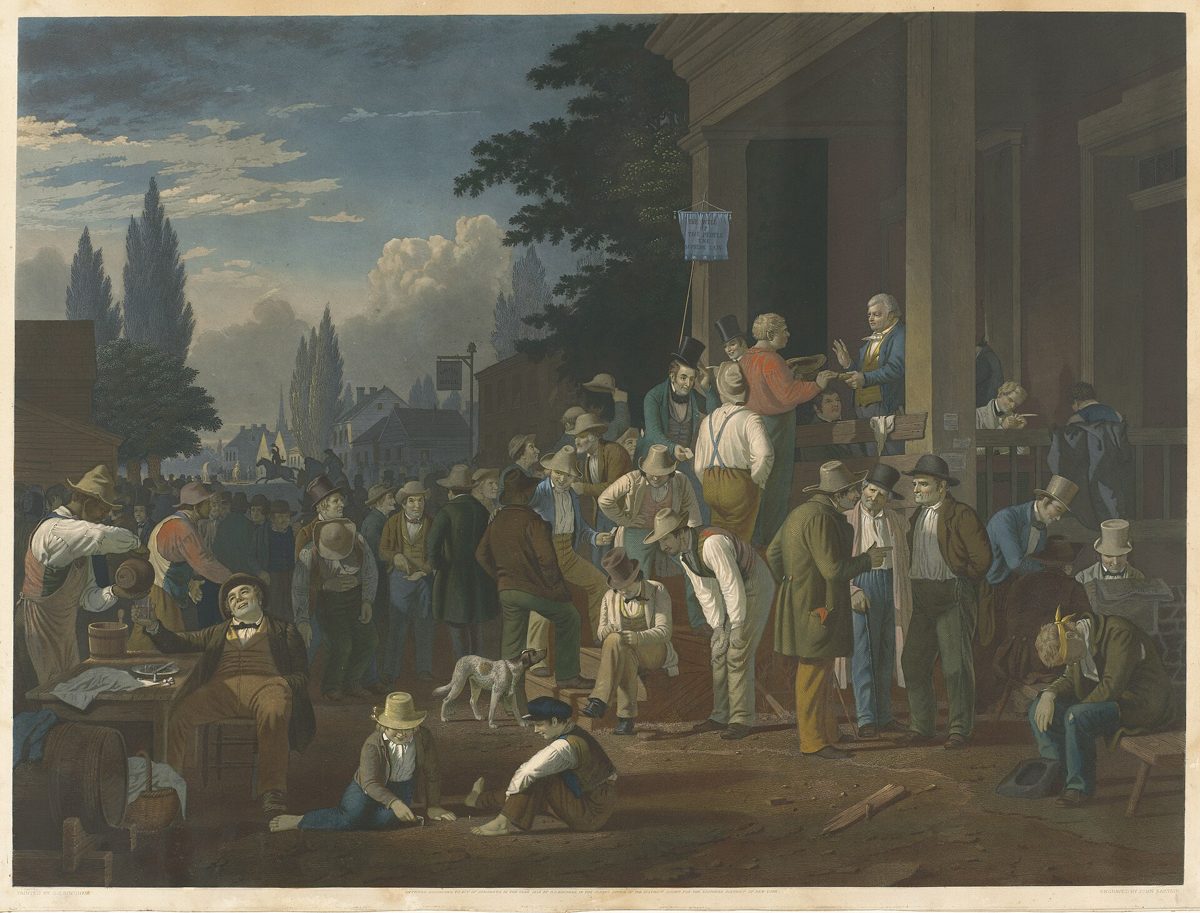
John Sartain after George Caleb Bingham, The County Election, 1854, hand-coloured etching, stipple, line engraving and mezzotint. National Gallery of Art, Washington. Public domain (CC0). Record
Picture labelling: The County Election (1854)Core
Look at the engraving after Bingham. Find:
the man taking an oath
the banner on the column
the crowd
a dog
boys playing
the building
Answer key
at the top of the steps, a man raises his hand in front of an official
The Will of the People the Supreme Law
in front of the building: only men
in the middle, near the voters
in the front, on the ground
a large building with columns, on the right
Word familiesCore
Complete.
to elect: an elector, ______ (adjective, as in ______ College)
to vote: a ______ (person)
to inaugurate: the ______
to certify: a ______ (document)
to win: a ______ (person)
major: a ______ (more than half)
Answer key
electoral, Electoral
voter
inauguration
certificate
winner
majority
Documents
Key document
Election Day is the first Tuesday after the first Monday in November. On that day, citizens vote for a president in their state. But the president is not elected directly: the votes are counted state by state, and each state has a number of electors. A state has as many electors as members of Congress: its representatives plus its two senators. Washington, D.C. has three. In total there are 538 electors. To win, a candidate needs at least 270, more than half. In 48 states and Washington, D.C., the winner of the state gets all its electors. Maine and Nebraska share theirs. The electors vote in December, Congress counts the votes in early January, and the new president is sworn in on 20 January.
Sources: USAGov and National Archives, Electoral College.
Look at the drawings
John Sartain after George Caleb Bingham, The County Election, 1854, hand-coloured etching, stipple, line engraving and mezzotint. National Gallery of Art, Washington. Public domain (CC0). Record
Activities
Read the diagram: where does the number 538 come from?
Calculate: California has 52 representatives. How many electors does it have? Wyoming has 1 representative: how many electors?
Say it: explain the diagram step by step with the passive and by: The president is elected by... The electoral votes are counted by... The new president is sworn in on...
Look at the 1854 engraving: who is voting? Who is not there? Compare with Election Day today.
Summary: Americans vote in their state; the states give electors; 270 electors make a president.
Grammar to say it: the passive voice (4), by + agent
Why we need it
To explain who chooses the president, we need the passive with by: The president is elected by the Electoral College. The votes are counted by Congress.
Grammar point: board explanation
Teacher script
Point to the diagram. Ask: Who elects the president? Write: The president is elected by the Electoral College.
Explain: by introduces the agent, the person or group that acts.
Ask: Do we need by in Senators are elected for six years? Explain why not: the agent is obvious or unknown.
Contrast by (who) and with (what tool): The ballot is marked with a pen.
Review prepositions of place: in a state, at the polling station, on the ballot.
Students copy, then do the quick check before the exercises.
Board: students copy
The passive voice (4): by + agent; prepositions by and with
Rule
by + agent (who does the action). Leave out the agent when it is obvious, unknown or not important.
Form
The president is elected by the Electoral College.The votes are counted by Congress.The bill was signed by the president. No agent: Senators are elected for six years.
Use
Keep by when the agent is new or important information.
Examples from the lesson
The president is elected by the Electoral College.
The electoral votes are counted by Congress in early January.
Senators are elected for six years.
Common mistakes
The president is elected from the electors. → by the electors.
The ballots are counted by someone. → The ballots are counted (no useful agent).
The ballot is marked by a pen. → with a pen (a tool).
French and English
par → by (agent); avec → with (tool). Le président est élu par les grands électeurs = The president is elected by the electors.
Also on the board: Prepositions of place
in a state, in the House, in Washington; at the polling station, at the Capitol; on the ballot, on Capitol Hill, on the map.
Quick check, with the whole class
The president is elected ______ the Electoral College.
The ballot is marked ______ a pen.
Keep by? Senators are elected for six years by people.
______ the polling station
______ the ballot
Answer key
by
with
No: Senators are elected for six years.
at
on
Grammar to say it: four stages
Stage 1. RecogniseEntry
Find the agent (after by). Write none if there is no agent.
The president is elected by the Electoral College.
Senators are elected for six years.
The votes are counted by Congress.
The ballots are counted in every state.
The bill was signed by the president.
The electors are chosen by the parties in each state.
The new president is sworn in on 20 January.
The projected winner is announced by the media on election night.
Answer key
the Electoral College
none
Congress
none
the president
the parties
none
the media
Stage 2. TransformCore
Rewrite in the passive. Keep by only when it is useful.
The electors choose the president.
Congress counts the electoral votes.
The president signed the bill.
People elect senators for six years.
Someone counts the ballots in every state.
The parties choose the electors.
The Supreme Court decided the case.
In 1800, the House chose Thomas Jefferson.
In 1824, the House selected John Quincy Adams.
The Chief Justice usually swears in the new president.
Answer key
The president is chosen by the electors.
The electoral votes are counted by Congress.
The bill was signed by the president.
Senators are elected for six years.
The ballots are counted in every state.
The electors are chosen by the parties.
The case was decided by the Supreme Court.
In 1800, Thomas Jefferson was chosen by the House.
In 1824, John Quincy Adams was selected by the House.
The new president is usually sworn in by the Chief Justice.
Stage 3. Guided productionCore
Explain the diagram step by step with the passive.
the votes / cast / citizens / on Election Day
all the electors of a state / give / to the winner
the president / elect / the electors / in December
the electoral votes / count / Congress / in early January
the new president / swear in / on 20 January
the result / announce / the media / on election night
when nobody has 270 / the president / choose / the House
in Maine and Nebraska / the electors / share
Answer key
The votes are cast by citizens on Election Day.
All the electors of a state are given to the winner.
The president is elected by the electors in December.
The electoral votes are counted by Congress in early January.
The new president is sworn in on 20 January.
The result is announced by the media on election night.
When nobody has 270 votes, the president is chosen by the House.
In Maine and Nebraska, the electors are shared.
Stage 4. Your turnStretch
Explain to a younger student who chooses the president: six sentences, at least four passives, with and without by.
Six sentences
Answer key
Model: Americans vote in November. Their votes are counted in each state. The electors of the state are given to the winner. The president is elected by 538 electors in December. The votes are counted by Congress in January. The new president is sworn in on 20 January.
Extra practice
A. Find the agentEntry
Who does the action? Find the agent after by.
The new president is usually sworn in by the Chief Justice.
Answer key
the Chief Justice
C. Now say it: who chooses the president?Stretch
Write the passive. Keep by only if it is useful.
Somebody counts the ballots in every state.
Answer key
The ballots are counted in every state.
Figures of speech: metonymy
Learn
Metonymy uses a place or an object to speak about the people linked to it. The White House announced means the president and his team. Capitol Hill means Congress. Washington often means the federal government.
The White House said no. Who said no?
Capitol Hill passed the law. Who passed it?
Washington and Paris disagree. Who disagrees?
The Oval Office is the president's office. What does The Oval Office decided mean?
Find a French example of metonymy (a place for the people).
Bingham's banner says The Will of the People the Supreme Law. Rewrite it in a full sentence.
Answer key
The president and his team.
Congress.
The American and the French governments.
The president decided.
Matignon (the Prime Minister), l'Élysée (the President), Bercy (the Ministry of the Economy).
The will of the people is the supreme law: the people decide.
Expression task: write it, say it
Core First write, then speak. Use the words and the grammar of the session.
Written task: a short FAQ on the Electoral College
Steps
Write five questions.
Answer each one in one or two sentences.
Use the passive with and without by.
Add the numbers 538 and 270.
Sentence starters
What is the Electoral College? It is ...
How many electors are there? There are ...
How is the president elected? The president is elected by ...
When are the votes counted? They are counted ...
What happens if nobody gets 270 votes? The president is chosen by ...
Model answer
What is the Electoral College? It is the group of 538 electors. How is the president elected? The president is elected by the electors, not directly by the people. How many votes are needed? 270. When are the votes counted? They are counted by Congress in early January. What happens if nobody gets 270? The president is chosen by the House.
Oral task: explain, your partner draws
Steps
Hide the diagram.
Explain it step by step.
Your partner draws it.
Compare with the real diagram.
Sentence starters
First, draw three boxes ...
In the first box, write ...
Then add ...
Finally, write ...
Model answer
First, draw three boxes. In the first box, write 435 representatives. In the second, 100 senators. In the third, 3 for Washington, D.C. Then add them: 538. Finally, write 270 to win.
Going further (B2 towards C1)
For students aiming at language studies
Formal register (B2)Going further
Replace the everyday word with the formal word from the list: to convene, to certify, to ratify, a faithless elector, to concede, a contingent election.
The electors meet in their states.
The state confirms the result officially.
The loser accepts defeat.
An elector who votes for another candidate.
The vote by the House when nobody has 270.
The states approve an amendment.
Answer key
convene
certifies
concedes
a faithless elector
a contingent election
ratify
Finer grammar: passive with modals and the perfectGoing further
Rule
Modal passive: The result must be certified. Perfect passive: The votes have been counted. Modal perfect passive: The result could have been contested.
The result / must / certify / by each state.
All the votes / have / count. (present perfect)
The president / can / remove / by Congress (impeachment and trial).
The rules / should / respect / by every state.
Answer key
The result must be certified by each state.
All the votes have been counted.
The president can be removed by Congress.
The rules should be respected by every state.
Translation, French to EnglishGoing further
Le président est élu par les grands électeurs.
Les votes sont comptés par le Congrès début janvier.
Le résultat doit être certifié par chaque État.
Si personne n'obtient 270 voix, le président est choisi par la Chambre.
Answer key
The president is elected by the electors.
The votes are counted by Congress in early January.
The result must be certified by each state.
If nobody gets 270 votes, the president is chosen by the House.
Text analysis: a compromise of 1787Going further
The Electoral College was designed at the Constitutional Convention in Philadelphia in 1787. The delegates disagreed: some wanted Congress to choose the president, others wanted a direct vote of the people. The Electoral College was a compromise between the two ideas. Each state was given as many electors as it had members of Congress. Critics say the system gives too much weight to a few swing states; supporters reply that it forces candidates to campaign across many different states.
Find two verbs in the passive.
What were the two ideas of the delegates?
Find a word meaning an agreement where both sides accept less.
Find the critics' argument and the supporters' argument.
Which linking punctuation separates the two opinions?
Answer key
was designed, was given.
Congress chooses the president, or the people vote directly.
a compromise.
Critics: too much weight to swing states. Supporters: candidates must campaign in many states.
The semicolon.
Argued task (200 to 250 words, or a two-minute oral)Going further
Should the United States replace the Electoral College with a national popular vote?
Steps
Explain the system briefly.
Arguments for keeping it.
Arguments for changing it (2000, 2016).
How it could be changed (constitutional amendment).
Your position.
Sentence starters
The system was designed in 1787 to ...
Its supporters claim that ...
Its critics point out that ...
It would have to be changed by ...
To my mind, ...
Key points
Key points: compromise of 1787; the popular vote winner lost in 2000 and 2016 (USAGov); swing states get all the attention; small states defend the system; a change needs a constitutional amendment (USAGov); clear position. Use modal passives (would have to be changed, could be replaced).
The ______ is the ceremony when the president starts the job.
Each state sends a ______ of its result to Congress.
The ______ vote is the vote of all the people.
In 48 states, the system is ______.
Answer key
Tuesday
538
270
electors
20 January
tie
inauguration
certificate
popular
winner-take-all
Link with the world of work
Maths link: a majority means more than half. Calculate half of 538, then explain why 270 is the magic number.
Levels
Level
Adjustment
Entry (guided B1)
Complete the diagram with the numbers given.
Core (B1)
Calculate the electors of three states and explain.
Stretch (B1+)
Explain why a candidate can win the votes of the people but lose in the Electoral College.
Oral
Explain the diagram to a partner in one minute.
Homework
Explain the Electoral College to a friend in five sentences, using the numbers 538 and 270.
Answer keyModel answer: Americans vote on a Tuesday in November. They vote in their state. Each state has electors. There are 538 electors in total. To win, a candidate needs 270 of them.