Session 3: The road to the White House: primaries and conventions
Recap check
What are the two main parties?
What are their symbols?
How many times can a person be elected president?
Answer key
The Democratic Party and the Republican Party.
The donkey for the Democrats, the elephant for the Republicans.
Twice (22nd Amendment).
Question: How does a person become a candidate for president?
Objectives
Put the steps of a presidential campaign in order
Understand primaries, caucuses and conventions
Use months and ordinal numbers: in January, the first Tuesday
What we need to say
In this session, you need to tell the story of past campaigns: what happened, and when.
To tell the steps of a campaign, we need these words: candidate, primary, caucus, convention, running mate, debate.
To tell what happened in the past without naming who did it, we need the past passive: Abraham Lincoln was chosen in Chicago in 1860. The banners were printed in 1876.
Words to say it
Word
Meaning
Example
a candidate
a person who wants to be elected
She is a candidate for president.
a primary
a vote to choose a party's candidate
Most states hold primaries.
a caucus
a party meeting to choose a candidate
Caucuses are meetings.
a convention
a big party meeting in summer
The convention chooses the candidate.
a running mate
the candidate for vice president
She announced her running mate.
a debate
a discussion between candidates on TV
The debates are in September and October.
Put in orderEntry
To tell the steps of a campaign, put the eight steps in the right order.
the electors vote
primaries and caucuses
Inauguration Day
candidates announce
TV debates
national conventions
Congress counts the votes
Election Day
Answer key
6
2
8
1
4
3
7
5
Who am I? (ten riddles)Core
Find the word. Word bank: a candidate, a banner, a delegate, a slogan, a convention, a debate, a running mate, a primary, the nominee, a campaign.
I am a vote to choose a party's candidate.
I am a big party meeting in summer.
I am the candidate for vice president.
I am a discussion between candidates on TV.
I am a person who wants to be elected.
I represent voters at the convention.
I am the candidate chosen by the party.
I am a short sentence that people remember.
I am a big poster with pictures and words.
I am all the actions to win an election.
Answer key
a primary
a convention
a running mate
a debate
a candidate
a delegate
the nominee
a slogan
a banner
a campaign
Word partnersCore
Match the verbs and the nouns to make phrases from the lesson.
hold
win
choose
take part in
run
launch
give
win
a. for president
b. a debate
c. a campaign
d. a running mate
e. a speech
f. the nomination
g. delegates
h. a primary
Answer key
h (a primary)
f (the nomination)
d (a running mate)
b (a debate)
a (for president)
c (a campaign)
e (a speech)
g (delegates)
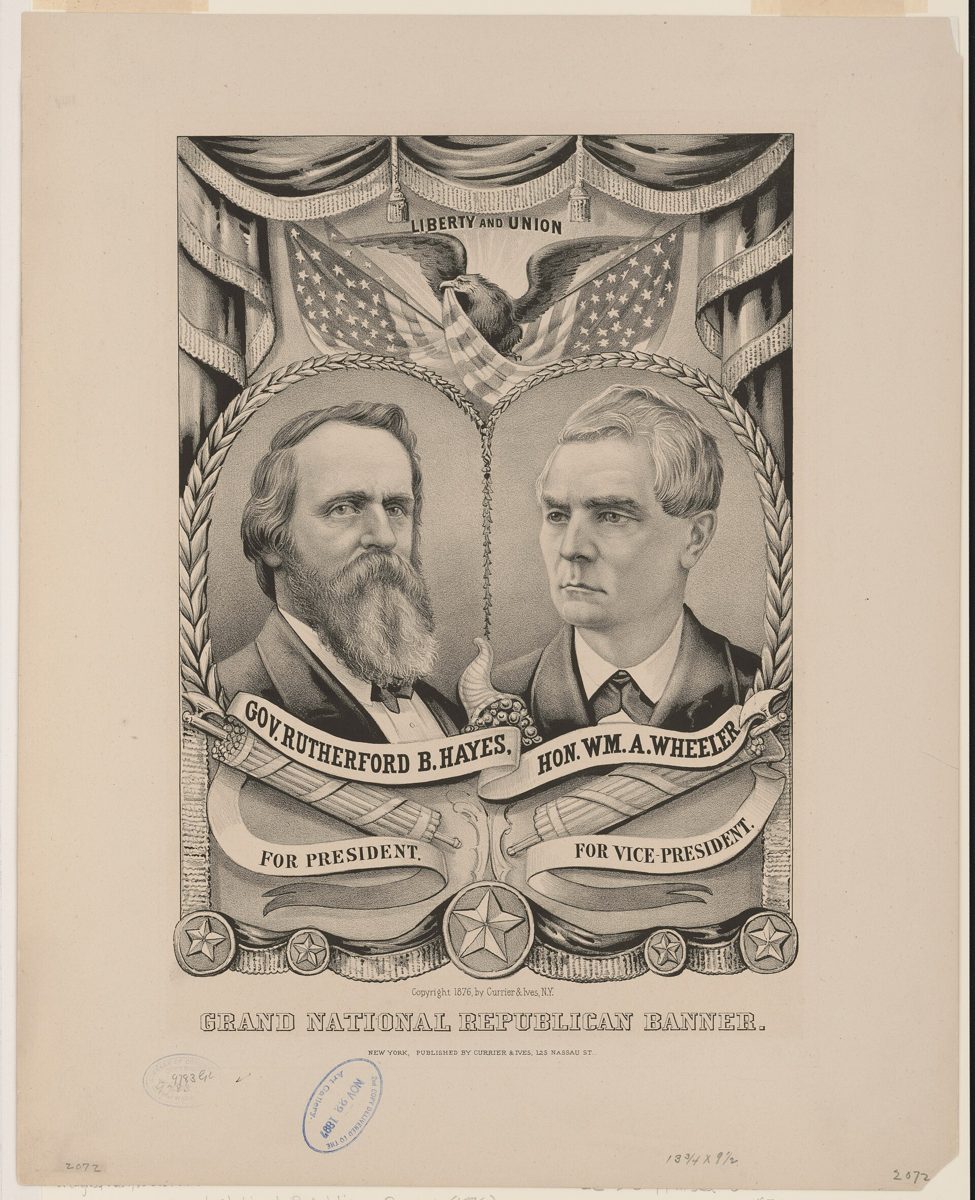
Unknown artist, Grand National Republican Banner (Rutherford B. Hayes and William A. Wheeler), 1876, lithograph. Library of Congress, Prints and Photographs Division. Public domain. Record
Picture labelling: the 1876 bannerCore
Look at the Grand National Republican Banner. Find:
the eagle
the flags
the words on the ribbon at the top
the candidate for president
the candidate for vice president
the title
Answer key
at the top, in the middle
on both sides of the eagle
Liberty and Union
on the left: Rutherford B. Hayes, governor of Ohio
on the right: William A. Wheeler
at the bottom: Grand National Republican Banner
Documents
Key document
The campaign takes almost two years. Candidates announce that they want to run. To be president, you must be at least thirty-five years old, a citizen born American and a resident for at least fourteen years. From January to June of the election year, each party organises primaries (secret votes) or caucuses (party meetings) in every state to choose its candidate. The winners get delegates. In summer, from July to early September, each party holds a national convention: the delegates choose the candidate, who announces a running mate. In September and October, the candidates meet in debates. The next presidential election is on 7 November 2028.
July to early Septembernational conventions, running mates
September and OctoberTV debates
Early NovemberElection Day
Decemberthe electors vote
Early JanuaryCongress counts the votes
20 JanuaryInauguration Day
Source: USAGov, presidential election process.
Look at the drawings
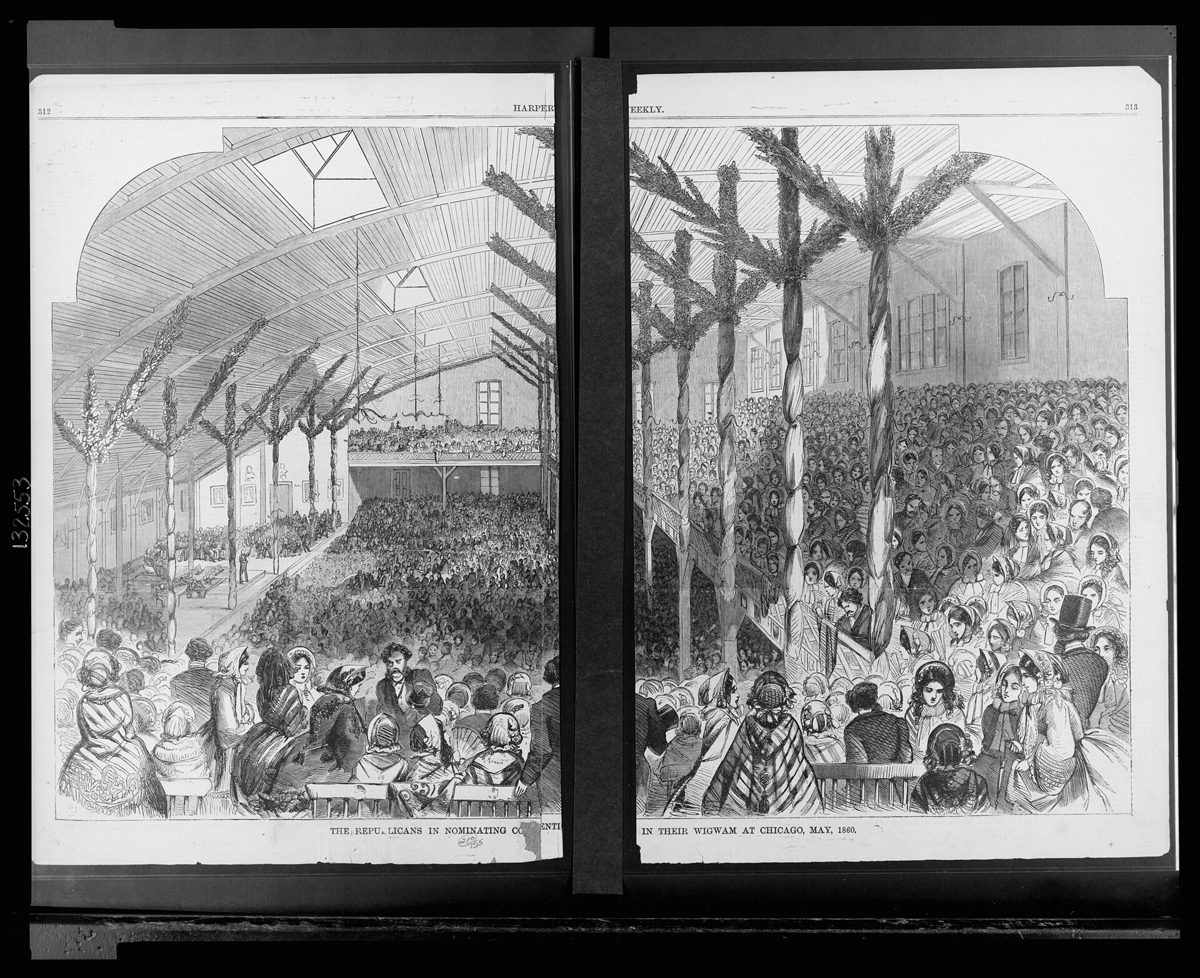
Unknown artist, The Republicans in Nominating Convention in their Wigwam at Chicago, May 1860, wood engraving, Harper's Weekly, 19 May 1860. Library of Congress, Prints and Photographs Division. Public domain. RecordUnknown artist, Grand National Republican Banner (Rutherford B. Hayes and William A. Wheeler), 1876, lithograph. Library of Congress, Prints and Photographs Division. Public domain. Record
Activities
Read the timeline: what happens in spring? In summer? In November?
Look at the 1860 convention: how many people can you see? Where are they? This convention chose Abraham Lincoln.
Say it: tell the story of the 1860 convention and of the 1876 banner in two sentences each, with was or were + past participle.
Look at the 1876 banner: who are the two men? Find the words that show it is a poster for a campaign.
Summary: primaries and caucuses, then a convention, then debates, then Election Day.
Grammar to say it: the passive voice (3), the past
Why we need it
To tell what happened in the past without naming who did it, we need the past passive: Abraham Lincoln was chosen in Chicago in 1860. The banners were printed in 1876.
Grammar point: board explanation
Teacher script
Ask: When was Lincoln chosen? Write the answer: Lincoln was chosen in 1860.
Compare on the board: is chosen (today, a rule) / was chosen (1860, finished). Explain: only be changes tense.
Ask: was or were? Make two columns: one thing → was, several → were.
Explain the past simple with finished dates and time markers: in 1860, last year, two years ago, then.
Explain in, on, at with times: in May, in 1860; on 18 May; at nine o'clock.
Students copy, then do the quick check on mini whiteboards.
Board: students copy
The passive voice (3): the past; past simple and time prepositions
Rule
Past simple passive = was / were + past participle.
Form
Lincoln was chosen in 1860.The banners were printed in 1876. Question: Was Lincoln chosen in Chicago? Negative: Seward was not chosen.
Use
To tell past events when the result matters: history, news reports.
Examples from the lesson
Abraham Lincoln was chosen in Chicago in May 1860.
The engraving was published by Harper's Weekly.
The delegates were elected in the primaries.
Common mistakes
Lincoln is chosen in 1860. → Lincoln was chosen in 1860 (finished date).
The banners was printed. → The banners were printed.
in 18 May → on 18 May; on 1860 → in 1860.
French and English
French uses the passé composé: Lincoln a été choisi en 1860. English uses the past simple with a finished date: Lincoln was chosen in 1860, not has been chosen.
Also on the board: Prepositions of time
in + month, year, season: in May, in 1860, in summer. on + day, date: on Tuesday, on 18 May. at + time: at nine o'clock, at night. ago after the period: two years ago.
Quick check, with the whole class
Lincoln ______ (choose) in 1860.
The posters ______ (print) in 1876.
______ May 1860
______ 18 May
Correct: The convention is held in Chicago in 1860.
Answer key
was chosen
were printed
in
on
The convention was held in Chicago in 1860.
Grammar to say it: four stages
Stage 1. RecogniseEntry
Present passive (PR) or past passive (PA)?
Lincoln was chosen in 1860.
The candidate is chosen at the convention.
The banners were printed in 1876.
The debates are watched on TV.
The Wigwam was built in Chicago.
Delegates are elected in the primaries.
The 1860 convention was held in Chicago.
The running mate is announced in summer.
Answer key
PA
PR
PA
PR
PA
PR
PA
PR
Stage 2. TransformCore
Rewrite in the past passive.
The party chose Lincoln in 1860.
They built the Wigwam in Chicago.
The Republicans chose Hayes and Wheeler in 1876.
The delegates nominated Lincoln.
Harper's Weekly published the engraving in May 1860.
Millions of people watched the first TV debates in 1960.
The candidate announced her running mate in summer.
Voters in each state chose the delegates.
A printer printed the banner in 1876.
The Library of Congress keeps the banner today.
Answer key
Lincoln was chosen by the party in 1860.
The Wigwam was built in Chicago.
Hayes and Wheeler were chosen by the Republicans in 1876.
Lincoln was nominated by the delegates.
The engraving was published by Harper's Weekly in May 1860.
The first TV debates were watched by millions of people in 1960.
The running mate was announced in summer.
The delegates were chosen by voters in each state.
The banner was printed in 1876.
The banner is kept by the Library of Congress today. (present: today)
Stage 3. Guided productionCore
Build a past passive sentence with the words.
the Wigwam / build / Chicago / 1860
Abraham Lincoln / choose / the Republicans / May 1860
the 1876 banner / print / for Hayes and Wheeler
the first TV debates / watch / 1960
the engraving / publish / Harper's Weekly
the delegates / elect / in the primaries
the running mate / announce / at the convention
the votes of the delegates / count / at the convention
Answer key
The Wigwam was built in Chicago in 1860.
Abraham Lincoln was chosen by the Republicans in May 1860.
The 1876 banner was printed for Hayes and Wheeler.
The first TV debates were watched in 1960.
The engraving was published by Harper's Weekly.
The delegates were elected in the primaries.
The running mate was announced at the convention.
The votes of the delegates were counted at the convention.
Stage 4. Your turnStretch
Tell the story of your imaginary candidate (from your banner) in six past passive sentences.
Six sentences
Answer key
Model: Sam Lee was chosen by the Green Party in March. Her slogan was written by students. Posters were printed in April. A big meeting was held in Lyon. Two debates were organised in October. In the end, she was elected by the class.
Extra practice
A. was or were?Entry
Choose was or were.
Lincoln ______ chosen in Chicago.
The posters ______ printed in 1876.
The convention ______ held in a big wooden hall.
The debates ______ watched on TV.
Answer key
was
were
was
were
B. Present to pastCore
Put the passive sentences in the past.
The delegates are elected in the primaries.
Answer key
The delegates were elected in the primaries.
C. Now say it: tell the story of past campaignsStretch
Build a past passive sentence with the words.
the Wigwam / build / in Chicago / in 1860
Hayes and Wheeler / choose / by the Republicans / in 1876
the first debates on TV / watch / by millions of people / in 1960
Answer key
The Wigwam was built in Chicago in 1860.
Hayes and Wheeler were chosen by the Republicans in 1876.
The first debates on TV were watched by millions of people in 1960.
Figures of speech: the sports metaphor
Learn
American politics often speaks about elections as a race: this is a sports metaphor. A candidate runs for president, the leader is the front-runner, a surprise candidate is a dark horse. In 1860, William Seward was the front-runner, but the convention chose Abraham Lincoln.
What does the race for the White House mean?
What does to run for president mean?
Who is the front-runner?
What is a dark horse?
Neck and neck means very close. Why is it a horse-racing image?
Write one sentence about a school election with a sports metaphor.
Answer key
The competition to become president.
To be a candidate.
The candidate who is winning before the vote.
A candidate nobody expected to win.
Two horses run so close that their necks are at the same level.
Example: Sara is the front-runner, but Tom is a dark horse.
Expression task: write it, say it
Core First write, then speak. Use the words and the grammar of the session.
Written task: a news report from the 1860 convention
Steps
Write the place and the date.
Say what happened (past passive).
Describe the place and the crowd.
Give a reaction.
Close with what comes next.
Sentence starters
Chicago, May 1860.
Yesterday, Abraham Lincoln was chosen ...
The convention was held in ...
The hall was full of ...
The election will be held in November.
Model answer
Chicago, May 1860. Yesterday, Abraham Lincoln was chosen as the Republican candidate. The convention was held in the Wigwam, a huge wooden hall. The hall was full of delegates and visitors. William Seward was the front-runner, but he was beaten. The election will be held in November.
Oral task: the story of your banner (one minute)
Steps
Show your banner.
Say how your candidate was chosen.
Give the slogan.
Ask for votes.
Sentence starters
This is the banner of ...
She was chosen by ...
Our slogan is ...
On Election Day, please vote for ...
Model answer
This is the banner of Sam Lee. She was chosen by the Green Party in March. Our slogan is Jobs for young people. On Election Day, please vote for Sam.
Going further (B2 towards C1)
For students aiming at language studies
Campaign vocabulary (B2)Going further
Match each phrase with its meaning.
to clinch the nomination
a campaign trail
a stump speech
a swing in the polls
a contested convention
to drop out of the race
a. a convention where no candidate has a majority at first
b. the journeys of a candidate across the country
c. to stop being a candidate
d. a sudden change in opinion
e. the standard speech repeated at every meeting
f. to win enough delegates to be sure of it
Answer key
f (to win enough delegates to be sure of it)
b (the journeys of a candidate across the country)
e (the standard speech repeated at every meeting)
d (a sudden change in opinion)
a (a convention where no candidate has a majority at first)
c (to stop being a candidate)
Finer grammar: past perfect passive and the passive with getGoing further
Rule
Past perfect passive: had been + past participle, for an action before another past action: When the convention opened, the delegates had already been chosen. Informal passive: get + past participle: He got elected in 1860.
When the convention opened, the delegates / already / choose.
By November 1860, Lincoln / nominate / for six months.
Seward / expect / to win, but he / beat.
The banner / print / before the campaign started.
Answer key
When the convention opened, the delegates had already been chosen.
By November 1860, Lincoln had been nominated for six months.
Seward had been expected to win, but he was beaten (got beaten).
The banner had been printed before the campaign started.
Translation, French to EnglishGoing further
Lincoln a été choisi à Chicago en 1860.
La convention a eu lieu dans un immense bâtiment en bois.
Les délégués avaient déjà été élus.
Personne ne s'attendait à sa victoire.
Answer key
Lincoln was chosen in Chicago in 1860.
The convention was held in a huge wooden building.
The delegates had already been elected.
Nobody expected him to win.
Text analysis: the surprise of 1860Going further
In May 1860, the Republican Party met in Chicago in a temporary wooden hall nicknamed the Wigwam. Most observers expected Senator William Seward of New York to be nominated. Lincoln's supporters, however, worked hard to win the delegates who did not want Seward. On the third ballot, Lincoln was chosen. Six months later, he was elected president, and the country soon entered the Civil War.
Find two past passives.
Which word shows the contrast with what was expected?
What does nicknamed mean?
Why was the result a surprise?
Find the time markers that organise the text.
Answer key
to be nominated, was chosen, was elected: any two.
however.
given an informal name.
Seward was the favourite; Lincoln was not expected to win.
In May 1860, on the third ballot, six months later, soon.
Argued task (200 to 250 words, or a two-minute oral)Going further
Are primaries and long campaigns good for democracy? Compare with the French presidential campaign.
Steps
Introduction: how long an American campaign lasts.
Advantages: voters know the candidates, many debates.
Drawbacks: cost, fatigue, money.
Comparison with France.
Conclusion.
Sentence starters
Whereas in France ..., in the United States ...
One advantage is that ...
A major drawback is ...
Had the campaign been shorter, ...
On balance, ...
Key points
Key points: campaigns last almost two years in the USA (USAGov); primaries let voters choose candidates; long and expensive; in France, parties organise primaries only sometimes and the official campaign is short; a nuanced conclusion with whereas and on balance.
Exercise
Put the steps in order: debates; conventions; Election Day; primaries and caucuses; candidates announce.