American citizens who are eighteen and, in most states, registered.
Women could vote in every state.
Question: Why is there a donkey and an elephant in American politics?
Objectives
Name the two main parties and their symbols
Describe a political cartoon
Use comparatives: bigger than, more famous than
What we need to say
In this session, you need to describe the cartoons, explain how the symbols are used, and correct wrong ideas.
To describe the cartoons and the parties, we need these words: party, symbol, cartoon, independent, term.
To explain how a symbol is used and to correct a wrong idea, we need passive questions and negatives: Is the donkey used by the Democrats? Yes, it is. The elephant is not used by the Democrats.
Words to say it
Word
Meaning
Example
a party
a group of people with the same political ideas
The Republican Party is one of the two main parties.
a symbol
a picture that represents an idea
The elephant is the symbol of the Republicans.
a cartoon
a funny drawing about the news
Thomas Nast drew political cartoons.
an independent
a politician who is not in a party
Two senators are independents.
a term
the time a person stays in office
A president's term is four years.
Odd one out (nine sets)Entry
To describe the parties and the cartoons, find the word that does not belong and say why.
donkey, elephant, ballot, lion
Democrat, Republican, independent, cartoon
term, year, month, symbol
cartoon, drawing, engraving, senator
red, blue, white, donkey
to draw, to vote, to elect, to choose
party, symbol, logo, emblem
Lincoln, Grant, Nast, Trump
magazine, newspaper, cartoonist, website
Answer key
ballot: the others are animals in the cartoons.
cartoon: the others are political labels.
symbol: the others are periods of time.
senator: the others are kinds of pictures.
donkey: the others are colours.
to draw: the others are about elections.
party: the others are pictures that represent something.
Nast: he was a cartoonist; the others were presidents.
cartoonist: a person; the others are media.
Definitions: write the wordCore
Read the definition and write the word. Word bank: a cartoonist, a party, the donkey, a term, a symbol, the elephant, an independent, a cartoon.
a funny drawing about the news
a person who draws cartoons
a group with the same political ideas
a picture that represents an idea
a politician who is not in a party
the time a person stays in office
the animal of the Democrats
the animal of the Republicans
Answer key
a cartoon
a cartoonist
a party
a symbol
an independent
a term
the donkey
the elephant
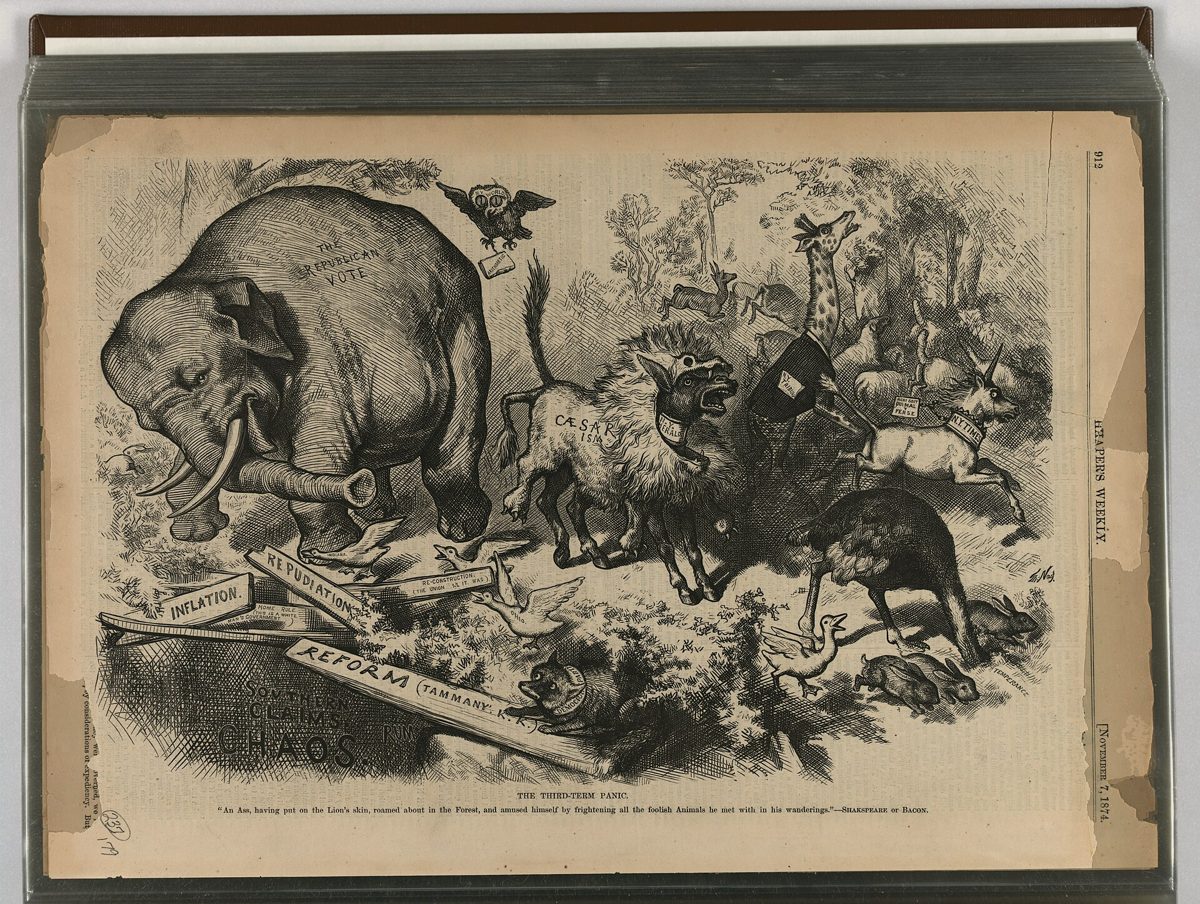
Thomas Nast, The Third-Term Panic, 1874, wood engraving, Harper's Weekly, 7 November 1874. Library of Congress, Prints and Photographs Division. Public domain. Record
Picture labelling: The Third-Term Panic (1874)Core
Look at Nast's cartoon. Find:
the elephant and the words written on it
the donkey in a lion skin
the word on the lion skin
three boards with words under the elephant
the hole the elephant may fall into
an owl
animals running away
Answer key
on the left: The Republican Vote
in the middle
Caesarism
Inflation, Repudiation, Reform
at the bottom left: the word Chaos
flying at the top
on the right: a giraffe, an ostrich, a unicorn, rabbits
Word familiesCore
Complete with the adjective or the person.
politics: ______ (adjective), a politician
democracy: ______ (adjective), a Democrat
a republic: ______ (adjective)
a symbol: ______ (adjective)
a cartoon: a ______ (person)
power: ______ (adjective)
Answer key
political
democratic
republican
symbolic
cartoonist
powerful
Documents
Key document
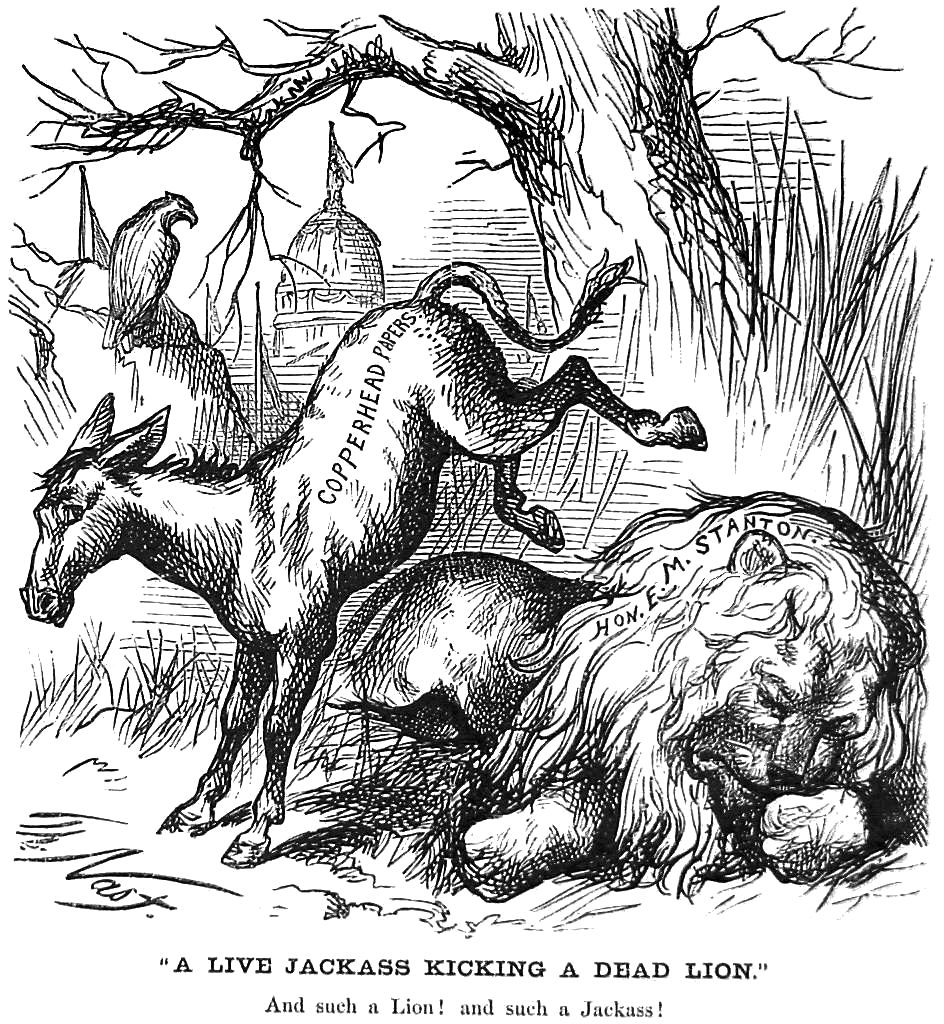
Two big parties dominate American politics: the Democratic Party and the Republican Party. Other parties and independent candidates exist, but they rarely win. The symbols of the two parties come from cartoons. The cartoonist Thomas Nast drew a donkey for the Democrats in 1870 and an elephant labelled The Republican Vote in 1874, in the magazine Harper's Weekly. The parties later adopted these animals. In the 1874 cartoon, the panic is about a third term for President Grant. Since the 22nd Amendment (1951), a person can be elected president only twice. In 2026, the President is Donald Trump, a Republican, and the Vice President is JD Vance.
the President (Donald Trump) and a majority in both chambers
The colours red and blue are a habit of TV channels and newspapers, fixed around the 2000 election; they are not official.
Look at the drawings
Thomas Nast, A Live Jackass Kicking a Dead Lion, 1870, wood engraving, Harper's Weekly, 19 January 1870. Public domain, via Wikimedia Commons. RecordThomas Nast, The Third-Term Panic, 1874, wood engraving, Harper's Weekly, 7 November 1874. Library of Congress, Prints and Photographs Division. Public domain. Record
Activities
Look at the two cartoons. Which animal do you see first? Where is it? What is it doing?
Complete the table: party, symbol, colour on election maps.
Say it: a partner says something wrong about the parties (The elephant is used by the Democrats). Correct it with the passive negative, then ask a passive question back.
Pair work: say which animal you find stronger, funnier, more serious, and why.
Summary: two parties, two animals, born in the drawings of one cartoonist.
Grammar to say it: the passive voice (2), questions and negatives
Why we need it
To explain how a symbol is used and to correct a wrong idea, we need passive questions and negatives: Is the donkey used by the Democrats? Yes, it is. The elephant is not used by the Democrats.
Grammar point: board explanation
Teacher script
Show Nast's elephant. Say something wrong on purpose: The elephant is used by the Democrats. Ask the class to correct you.
Write the correction: The elephant is not used by the Democrats. Underline is not + used.
Write the question: Is the elephant used by the Republicans? Show that is moves before the subject, as with all questions with be.
Practise short answers in a chain: Yes, it is. / No, it isn't.
Explain the position of adjectives: always before the noun, never plural. Write: a big grey elephant, the Republican voters.
Students copy the board, then do the quick check in pairs.
Board: students copy
The passive voice (2): questions and negatives; adjectives
Rule
Negative: is / are not + past participle. Question: Is / Are + subject + past participle?
Form
The donkey is not used by the Republicans. Is the donkey used by the Democrats? Yes, it is. / No, it isn't.
Use
To correct a wrong idea, to check information, to ask about how something is done.
Examples from the lesson
The colours are not fixed by law.
Are independents often elected? No, they aren't.
Is the president elected for six years? No, he isn't.
Common mistakes
Does the donkey used by the Democrats? → Is the donkey used ...?
The elephant don't used. → The elephant is not used.
the Republicans voters → the Republican voters (an adjective never takes -s).
French and English
French: un gros éléphant gris (adjective after the noun). English: a big grey elephant (adjectives before the noun; opinion, size, age, colour, origin).
Also on the board: Word order: adjectives
Adjectives go before the noun and never take -s: a famous cartoon, two political parties. Order: opinion, size, age, colour, origin, noun: a funny old American cartoon.
Quick check, with the whole class
Negative: The elephant is used by the Democrats.
Question: The donkey is used by the Democrats.
Short answer: Are the colours fixed by law? No, ...
Put in order: cartoon / American / old / an
Correct: the Democrats voters
Answer key
The elephant is not used by the Democrats.
Is the donkey used by the Democrats?
they aren't.
an old American cartoon
the Democratic voters
Grammar to say it: four stages
Stage 1. RecogniseEntry
Question (Q), negative (N) or affirmative (A)? All the sentences are passive.
Is the donkey used by the Democrats?
The elephant is not used by the Democrats.
Red is used for the Republicans on TV maps.
Are third parties elected often?
The colours are not fixed by law.
Nast's cartoons are known all over the world.
Is the president elected for six years?
Independents are not elected very often.
Answer key
Q
N
A
Q
N
A
Q
N
Stage 2. TransformCore
Make the sentence negative (1 to 4), then make a question (5 to 8).
The elephant is used by the Democrats.
The president is elected for six years.
Third parties are elected very often.
The colours are fixed by law.
The donkey is used by the Democrats.
Nast's cartoons are known today.
Blue is used for the Democrats.
The president is elected every four years.
Answer key
The elephant is not used by the Democrats.
The president is not elected for six years.
Third parties are not elected very often.
The colours are not fixed by law.
Is the donkey used by the Democrats?
Are Nast's cartoons known today?
Is blue used for the Democrats?
Is the president elected every four years?
Stage 3. Guided productionCore
Your partner is wrong. Correct each idea with a passive negative, then give the right information.
The elephant is used by the Democrats.
Blue is used for the Republicans.
The president is elected for six years.
The symbols are chosen by law.
In The Third-Term Panic, the elephant is dressed in a lion skin.
Independents are elected very often.
A president can be elected three times.
The 1874 cartoon was printed in a French magazine.
Answer key
No, it is not used by the Democrats. It is used by the Republicans.
No, it is not. Red is used for the Republicans.
No, he is not. The president is elected for four years.
No, they are not chosen by law. They come from cartoons.
No, it is not. The donkey is dressed in a lion skin.
No, they are not. They are rarely elected.
No, a president cannot be elected three times. A president can be elected only twice.
No, it was not. It was printed in Harper's Weekly, an American magazine.
Stage 4. Your turnStretch
Quiz master: write five passive questions about the parties and the cartoons, with the answers. Ask your partner.
Five questions
Answer key
Model: Is the elephant used by the Republicans? Yes, it is. Is the donkey used by the Republicans? No, it is not. Are the colours fixed by law? No, they are not. Is a president elected for four years? Yes. Are Nast's cartoons known today? Yes, they are.
Extra practice
A. Past participlesEntry
Write the past participle.
draw
use
know
see
elect
Answer key
drawn
used
known
seen
elected
C. Now say it: ask and answer about the symbolsStretch
Build a passive question with the words, then answer it.
donkey / use / Democrats?
colours / fix / by law?
Nast's cartoons / know / today?
Answer key
Is the donkey used by the Democrats? Yes, it is.
Are the colours fixed by law? No, they are not.
Are Nast's cartoons known today? Yes, they are.
Figures of speech: personification and the fable
Learn
In Nast's cartoons, animals act like people: this is personification. A fable is a short story with animals and a lesson. The 1874 cartoon plays with Aesop's fable The Ass in the Lion's Skin: a donkey wears a lion skin to frighten the other animals.
What does the elephant stand for in 1874?
Why does the donkey wear a lion skin?
What is the lesson of Aesop's fable?
Which animals are frightened and run away?
The idiom the elephant in the room means a big problem nobody talks about. Use it in a sentence about your school.
Which animal would you choose for your class, and why?
Answer key
The Republican vote.
To look strong and frightening.
You can look dangerous, but people will find out who you really are.
A giraffe, an ostrich, a unicorn, rabbits, ducks.
Example: The noise in the canteen is the elephant in the room.
Open answer with because.
Expression task: write it, say it
Core First write, then speak. Use the words and the grammar of the session.
Written task: describe a cartoon (80 to 100 words)
Steps
Who drew it, when, where?
Describe the foreground and the background.
Explain the symbols.
Give the message.
Give your opinion.
Sentence starters
This cartoon was drawn by ... in ...
In the foreground, we can see ...
The elephant stands for ...
The cartoonist wants to show that ...
In my opinion, ...
Model answer
This cartoon was drawn by Thomas Nast in 1874 for Harper's Weekly. In the foreground, a big elephant called The Republican Vote is near a hole. In the middle, a donkey wears a lion skin and frightens the other animals. The elephant stands for the Republican voters. The cartoonist wants to show that people panic for nothing. In my opinion, the cartoon is funny and clever.
Oral task: present your party symbol (thirty seconds)
Steps
Name your party.
Show the symbol.
Explain why.
Give one promise.
Sentence starters
My party is called ...
Our symbol is ...
We chose it because ...
If you vote for us, ...
Model answer
My party is called the Bee Party. Our symbol is a bee. We chose it because bees work together. Our promise: more green spaces in town.
Going further (B2 towards C1)
For students aiming at language studies
Political idiomsGoing further
Match each idiom with its meaning.
a grassroots movement
to toe the party line
a partisan divide
to cross the aisle
a third-party candidate
a political heavyweight
a. to work with the other party
b. a movement started by ordinary people
c. a strong split between the parties
d. a very important politician
e. to follow the party's official position
f. a candidate from neither main party
Answer key
b (a movement started by ordinary people)
e (to follow the party's official position)
c (a strong split between the parties)
a (to work with the other party)
f (a candidate from neither main party)
d (a very important politician)
Finer grammar: the reporting passiveGoing further
Rule
It is said / believed / thought that + clause, or subject + is said to + infinitive. It is said that Nast created the elephant symbol. = Nast is said to have created the elephant symbol.
People say that Nast invented the party animals. (It is said ...)
People believe that cartoons influence voters. (Cartoons are believed ...)
People think that the colours were fixed around 2000. (The colours are thought ...)
People know that independents rarely win. (It is known ...)
Answer key
It is said that Nast invented the party animals.
Cartoons are believed to influence voters.
The colours are thought to have been fixed around 2000.
It is known that independents rarely win.
Translation, French to EnglishGoing further
L'éléphant n'est pas utilisé par les démocrates.
Est-ce que l'âne est utilisé par les démocrates ?
On dit que Nast a inventé ces symboles.
Ces dessins sont encore connus aujourd'hui.
Answer key
The elephant is not used by the Democrats.
Is the donkey used by the Democrats?
It is said that Nast invented these symbols. / Nast is said to have invented these symbols.
These cartoons are still known today.
Text analysis: a cartoonist who shaped politicsGoing further
Thomas Nast, a German-born illustrator, worked for Harper's Weekly for more than twenty years. His drawings were seen by hundreds of thousands of readers at a time when many Americans could not read long articles. He did not invent the donkey from nothing, but his cartoons made both animals famous, and the parties eventually adopted them. Nast also attacked corruption in New York City: his cartoons against the political boss William Tweed were so effective that Tweed is reported to have complained about those damned pictures.
Find a reporting passive in the text.
Why were cartoons powerful at that time?
Find a word meaning in the end.
What does effective mean? Give a synonym.
Is the author for or against Nast? Justify with two words from the text.
Answer key
Tweed is reported to have complained.
Many readers could not read long articles; pictures reach everybody.
eventually.
successful, efficient.
Rather for: made famous, so effective.
Argued task (200 to 250 words, or a two-minute oral)Going further
Can a cartoon be more powerful than a long article? Use examples from the sequence and from today (memes, comic strips).
Steps
Introduction with an example.
Why images convince.
Limits: simplification, humour, manipulation.
Your conclusion.
Sentence starters
At first sight, ...
A picture is said to be worth a thousand words, ...
However, it could be argued that ...
Not only ... but also ...
In the end, ...
Key points
Key points: Nast's cartoons reached readers who did not read long texts; symbols are easy to remember; memes today work the same way; limits: images simplify, can mislead, need context; balanced conclusion. Use one reporting passive and one concession (although, however).
Exercise
Complete with a comparative: 1. An elephant is (big) than a donkey. 2. The Democratic Party is (old) than the Republican Party. 3. For me, this cartoon is (funny) than the other one.
Answer key1. bigger. 2. older (it was founded in 1828, the Republican Party in 1854). 3. funnier (any reasoned answer is accepted).
Gap-fill worksheet
Word bank: donkey, elephant, Nast, twice, Republican, cartoonist, party, colour, independent, term
The symbol of the Democrats is a ______.
The symbol of the Republicans is an ______.
Thomas ______ drew both animals.
A person can be elected president only ______.
Donald Trump is a ______ president.
Thomas Nast was a famous ______.
A ______ is a group with the same political ideas.
Red is the ______ of the Republicans on TV maps.
Bernie Sanders is an ______ senator.
The ______ of a president is four years.
Answer key
donkey
elephant
Nast
twice
Republican
cartoonist
party
colour
independent
term
Link with the world of work
Companies and brands also use symbols and logos. Choose a logo you know and say what it wants to tell customers.
Levels
Level
Adjustment
Entry (guided B1)
Complete the table with the words given.
Core (B1)
Describe one cartoon in five sentences.
Stretch (B1+)
Compare the two cartoons with comparatives and whereas.
Oral
Present your invented party symbol in thirty seconds.
Homework
Invent a symbol for a new party (an animal or an object) and explain your choice in four sentences.
Answer keyModel answer: My party is the Bee Party. Its symbol is a bee because bees work together. They are small but useful. Our colour is yellow.