For example George Washington, Abraham Lincoln, Barack Obama, Donald Trump: all correct answers are accepted.
To choose a person or an answer, for example by putting a ballot in a ballot box.
At eighteen.
Question: Who can vote in the United States, and who does what in Washington?
Objectives
Name the three branches of the American government
Say who can vote today
Read a drawing from 1867 and a cartoon from 1915
What we need to say
In this session, you need to explain who does what in Washington, and who is given the vote.
To talk about voting, we need these words: citizen, vote, ballot, register, branch.
To say what is done, and by whom, we need the passive: The laws are made by Congress. The vote is given to citizens at eighteen.
Words to say it
Word
Meaning
Example
a citizen
a person who belongs to a country
She is an American citizen.
to vote
to choose in an election
You can vote at eighteen.
a ballot
the paper or form you use to vote
He puts his ballot in the box.
to register
to put your name on the list of voters
Most Americans must register before they vote.
a branch
one part of the government
Congress is one branch.
Matching (ten words)Entry
To talk about voting, match each word with its meaning.
a citizen
to vote
a ballot
a ballot box
to register
a branch
a right
an amendment
a voter
an election
a. the box where you put your ballot
b. a change added to the Constitution
c. to choose in an election
d. one part of the government
e. a person who votes
f. a person who belongs to a country
g. the moment when people choose their leaders
h. to put your name on the list of voters
i. the paper or form you use to vote
j. something the law allows you to do
Answer key
f
c
i
a
h
d
j
b
e
g
Word familiesCore
To explain who does what, you need the verb, the noun and the person. Complete.
to vote: a vote, a ______
to elect: an ______, an elector
to govern: the ______, a governor
to register: ______ (the action)
to represent: a ______ (the person)
to judge: a ______ (the person), a judgement
to lead: a ______ (the person)
to amend: an ______
Answer key
voter
election
government
registration
representative
judge
leader
amendment
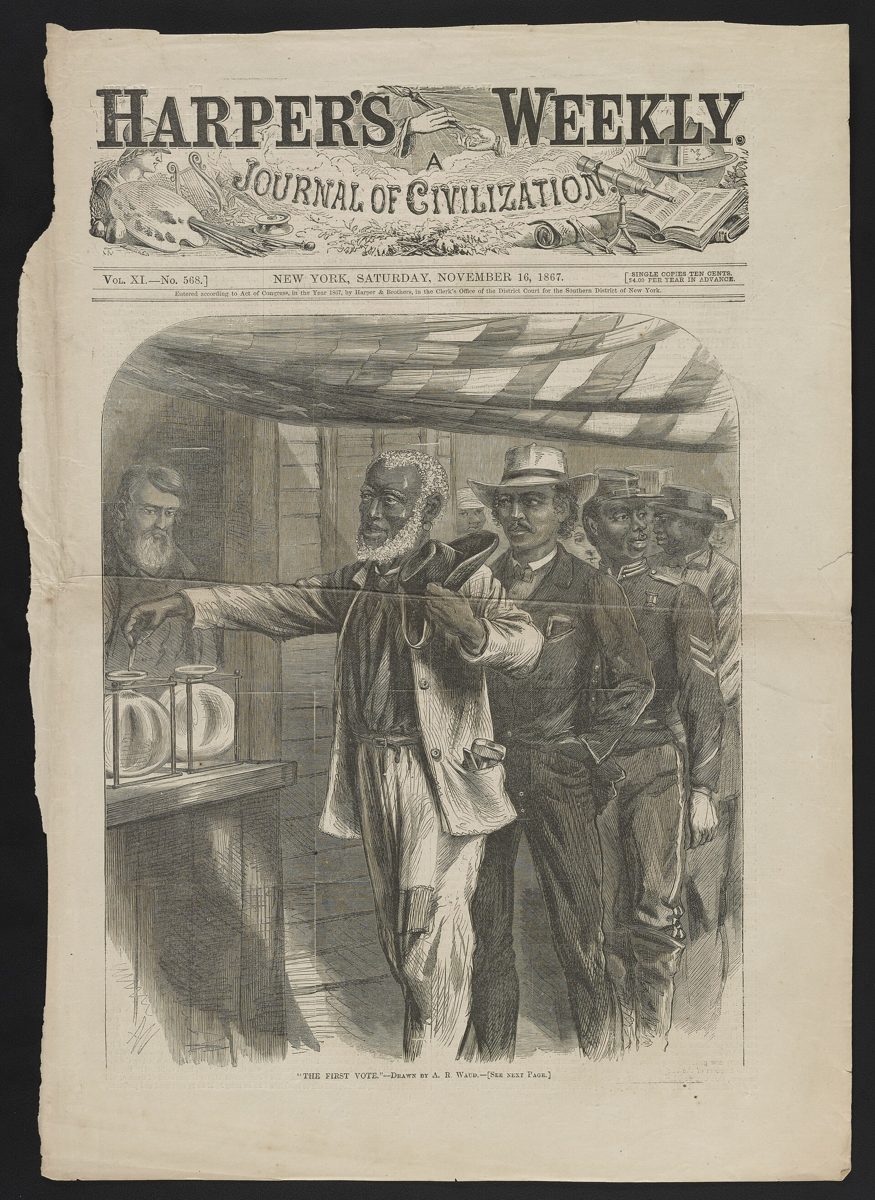
Alfred R. Waud, The First Vote, 1867, wood engraving, cover of Harper's Weekly, 16 November 1867. Library of Congress, Prints and Photographs Division. Public domain. Record
Picture labelling: The First Vote (1867)Core
Look at the cover of Harper's Weekly. Find and describe where you see:
the ballot boxes
the man who is voting
a man in a soldier's uniform
a man in a hat and a smart suit
the man who watches the vote
the title and the date
Answer key
on the left, two round glass boxes on a table
in front: an old man with a white beard puts his ballot in the box
in the queue, the third man, with a cap and stripes on his sleeve
just behind the voter
behind the ballot boxes, on the left: a white man with a beard
at the top: Harper's Weekly, 16 November 1867
Documents
Key document
The government of the United States has three branches. Congress makes the laws. The President carries out the laws and leads the country. The Supreme Court decides what the Constitution means. Today, you can vote in a federal election if you are an American citizen, if you are eighteen on Election Day and, in almost every state, if you are registered on the list of voters. This was not always the case: the 15th Amendment (1870) says the right to vote cannot be refused because of race, the 19th Amendment (1920) gives the vote to women and the 26th Amendment (1971) lowers the voting age to eighteen.
ExecutiveThe President carries out the laws + Vice President
JudicialThe Supreme Court says what the Constitution means
Look at the drawings
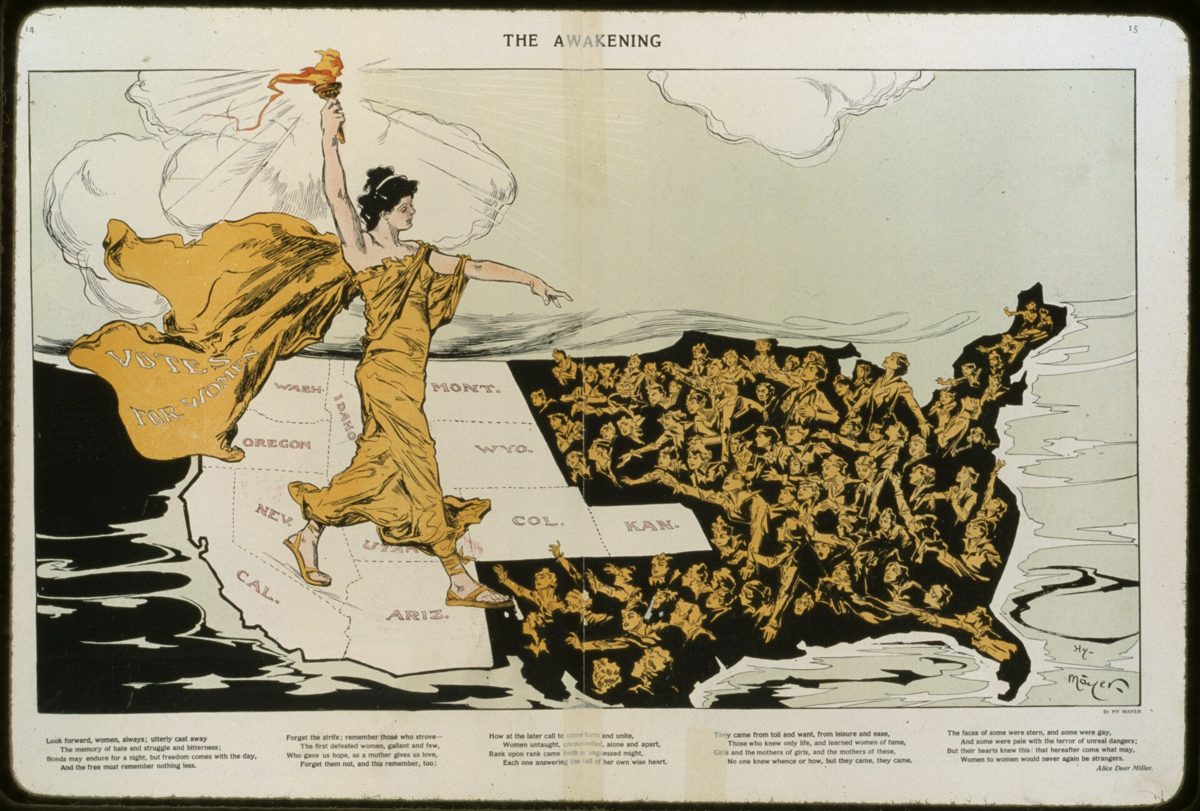
Alfred R. Waud, The First Vote, 1867, wood engraving, cover of Harper's Weekly, 16 November 1867. Library of Congress, Prints and Photographs Division. Public domain. RecordHenry (Hy) Mayer, The Awakening, 1915, colour offset print, centrefold of Puck, 20 February 1915. Library of Congress, Prints and Photographs Division. Public domain. Record
Activities
Look at the diagram: which branch makes the laws? Which branch judges?
Describe the 1867 drawing: who is voting? Who is waiting? What are they wearing? Use there is, there are and the present continuous.
Say it: explain who does what. The laws are made by ______. The laws are carried out by ______. The Constitution is explained by ______. (Use the passive: see Grammar to say it.)
Look at the 1915 cartoon: the lit part of the map shows the states where women could already vote. Where are they: in the West or in the East?
Summary: in the United States, citizens choose the people who govern, but the right to vote was won step by step.
Grammar to say it: the passive voice (1), the form
Why we need it
To say what is done, and by whom, we need the passive: The laws are made by Congress. The vote is given to citizens at eighteen.
Grammar point: board explanation
Teacher script
Show the diagram of the three branches. Ask: Who makes the laws? Students answer: Congress makes the laws.
Write the active sentence on the board. Ask: What is more important here, Congress or the laws? Then write the passive sentence under it.
Circle are + made. Explain: passive = be + past participle. Be shows the tense, the participle shows the action.
Ask students to find the agent after by. Explain that we often leave it out when it is obvious.
Explain the present simple: we use it for facts and rules that are always true. Underline the time markers: every four years, always, today.
Students copy the board. Then do the quick check together, orally, before the exercises.
Board: students copy
The passive voice (1) and the present simple for facts
Rule
Passive = be + past participle. The object of the active sentence becomes the subject.
Form
Present simple passive: am / is / are + past participle (+ by + agent). Regular: elect → elected. Irregular: make → made, choose → chosen, give → given, hold → held, put → put.
Use
When the action or the result matters more than the person who acts; in rules, institutions and news. The present simple is used for facts that are always true.
Examples from the lesson
Congress makes the laws. → The laws are made by Congress.
The president is elected every four years.
The right to vote is protected by the Constitution.
Common mistakes
The laws are make by Congress. → The laws are made by Congress.
The president elected every four years. → The president is elected every four years.
The laws is made. → The laws are made (plural subject).
French and English
French often uses on: On élit le président tous les quatre ans. English prefers the passive: The president is elected every four years.Par = by.
Also on the board: Tenses and time markers: the present simple
Facts and habits: Americans vote in November. Third person singular: -s: Congress makes, the president signs. Time markers: every, always, usually, today, in November.
Quick check, with the whole class
The laws ______ (make) by Congress.
The president ______ (elect) every four years.
Past participle of choose?
Find the agent: The Constitution is explained by the Supreme Court.
Correct: The ballot are put in the box.
Answer key
are made
is elected
chosen
the Supreme Court
The ballot is put in the box.
Grammar to say it: four stages
Stage 1. RecogniseEntry
Active (A) or passive (P)? Underline the verb.
Congress makes the laws.
The laws are made by Congress.
The president is chosen every four years.
Citizens vote at eighteen.
The Constitution is explained by the Supreme Court.
Voters are registered on a list in most states.
The Supreme Court judges cases.
The ballots are put in a box.
Women vote in every state today.
The right to vote is protected by the Constitution.
Answer key
A: makes
P: are made
P: is chosen
A: vote
P: is explained
P: are registered
A: judges
P: are put
A: vote
P: is protected
Stage 2. TransformCore
Rewrite in the present passive. Keep by + agent.
Congress makes the laws.
The President carries out the laws.
The Supreme Court explains the Constitution.
Citizens choose the members of Congress.
The states organise the elections.
Voters put the ballots in the box.
The election office counts the votes.
The Constitution protects the right to vote.
The states keep the lists of voters.
Harper's Weekly prints the drawing on its cover.
Answer key
The laws are made by Congress.
The laws are carried out by the President.
The Constitution is explained by the Supreme Court.
The members of Congress are chosen by citizens.
The elections are organised by the states.
The ballots are put in the box by voters.
The votes are counted by the election office.
The right to vote is protected by the Constitution.
The lists of voters are kept by the states.
The drawing is printed by Harper's Weekly on its cover.
Stage 3. Guided productionCore
Build a present passive sentence with the words.
the laws / make / Congress
the president / elect / every four years
the votes / count / in every state
the Constitution / explain / the Supreme Court
the ballot / put / in the ballot box
voters / register / on a list
the vote / give / to citizens at eighteen
the members of Congress / choose / the voters
Answer key
The laws are made by Congress.
The president is elected every four years.
The votes are counted in every state.
The Constitution is explained by the Supreme Court.
The ballot is put in the ballot box.
Voters are registered on a list.
The vote is given to citizens at eighteen.
The members of Congress are chosen by the voters.
Stage 4. Your turnStretch
Who does what in France or in your school? Write five passive sentences.
Five sentences
Answer key
Model: In France, the President is elected by the people. The laws are voted by Parliament. In my school, the timetable is made by the head teacher. The class representatives are elected by the students. The canteen menu is chosen by the cook.
Extra practice
B. Complete with is or are + past participleCore
Use the verb in brackets.
The laws ______ (make) by Congress.
The president ______ (elect) every four years.
The ballots ______ (put) in a box.
The right to vote ______ (give) to citizens at eighteen.
Answer key
are made
is elected
are put
is given
C. Now say it: who does what?Stretch
Rewrite the sentences in the passive.
The Supreme Court judges the cases.
Answer key
The cases are judged by the Supreme Court.
Figures of speech: the symbol and the metaphor
Learn
A symbol is a picture that stands for an idea. A metaphor describes one thing as if it were another. In The Awakening (1915), the light of the torch stands for the vote. When we say women won the vote, the vote becomes a prize or a battle.
In the 1915 cartoon, what does the light stand for?
What do the dark states stand for?
Find the metaphor: The vote was a long battle for women.
Which verb turns the vote into a prize: won or lost?
In The First Vote, the voters stand in a line: what does the long queue suggest?
Invent your own metaphor: The ballot is a ______ because ______.
Answer key
The vote for women.
The states where women could not vote yet.
a long battle: the struggle for the vote is described as a war.
won.
Many people are waiting for this new right; it is a long and important moment.
Example: The ballot is a key because it opens the door to decisions.
Expression task: write it, say it
Core First write, then speak. Use the words and the grammar of the session.
Written task: a short article for the school website
Steps
Give a title.
Explain the three branches with the passive.
Say who can vote today.
Present one date and the drawing of 1867.
Finish with your opinion.
Sentence starters
In the United States, the laws are made by ...
The laws are carried out by ...
To vote, you must be ...
In 1867, a drawing was published in ...
In my opinion, voting is important because ...
Model answer
Who governs in the USA? In the United States, the laws are made by Congress. They are carried out by the President, and the Constitution is explained by the Supreme Court. To vote, you must be a citizen and eighteen. In 1867, a drawing called The First Vote was published in Harper's Weekly. In my opinion, voting is important because it gives everyone a voice.
Oral task: present The First Vote in one minute
Steps
Say what it is.
Describe the foreground and the background.
Explain the message.
Give your opinion.
Sentence starters
This is the cover of ... from ...
In the foreground, there is ...
In the background, I can see ...
This drawing shows that ...
I think it is important because ...
Model answer
This is the cover of Harper's Weekly from November 1867. In the foreground, an old man puts his ballot in a glass box. Behind him, a man in a suit and a soldier are waiting. This drawing shows that Black men could vote for the first time. I think it is important because voting is a right for all citizens.
Going further (B2 towards C1)
For students aiming at language studies
Collocations and registerGoing further
Match each formal phrase with its everyday meaning.
to cast a ballot
to be eligible to vote
to enfranchise
to disenfranchise
the electorate
universal suffrage
voter turnout
to uphold the Constitution
a. the share of voters who actually vote
b. to vote
c. to have the right to vote
d. to take away the right to vote
e. the vote for all adults
f. all the people who can vote
g. to give the right to vote
h. to defend and respect it
Answer key
b (to vote)
c (to have the right to vote)
g (to give the right to vote)
d (to take away the right to vote)
f (all the people who can vote)
e (the vote for all adults)
a (the share of voters who actually vote)
h (to defend and respect it)
Finer grammar: the passive with modals and perfect tensesGoing further
Rule
Modal + be + past participle: The vote cannot be refused because of race. Present perfect: has / have been + past participle: The voting age has been lowered to eighteen.
The vote / cannot / refuse / because of race (15th Amendment).
The voting age / have / lower / to eighteen (since 1971).
Women / have / give / the vote in every state (since 1920).
Voters / must / register / before Election Day (most states).
The Constitution / can / amend / by Congress and the states.
Answer key
The vote cannot be refused because of race.
The voting age has been lowered to eighteen.
Women have been given the vote in every state.
Voters must be registered before Election Day.
The Constitution can be amended by Congress and the states.
Translation, French to EnglishGoing further
Les lois sont votées par le Congrès.
Le droit de vote ne peut pas être refusé à cause de la race.
Les femmes ont obtenu le droit de vote en 1920.
Le président est élu tous les quatre ans.
Answer key
The laws are passed by Congress.
The right to vote cannot be refused because of race.
Women won (were given) the right to vote in 1920.
The president is elected every four years.
Text analysis: a right won step by stepGoing further
When the Constitution was written in 1787, it said very little about who could vote: each state decided. Over almost two centuries, the right was widened by amendments. In 1870, the 15th Amendment stated that the vote could not be denied because of race, yet many Black citizens were kept from the polls for decades by local rules. In 1920, the 19th Amendment extended the vote to women in every state. In 1971, the 26th Amendment lowered the voting age to eighteen, at a time when young Americans were being sent to fight in Vietnam.
Find three passive forms and give their tense.
What does widened mean here? Give a synonym.
Which word shows a contrast in the fourth sentence?
Why was the voting age lowered in 1971, according to the text?
In your own words, explain the title.
Answer key
was written (past), was widened (past), could not be denied (modal past), were kept (past), were being sent (past continuous): any three.
made larger, extended.
yet.
Young people were sent to fight in Vietnam but could not vote: it seemed unfair.
The right to vote did not arrive all at once: it was extended in several stages, by amendments.
Argued task (200 to 250 words, or a two-minute oral)Going further
Should the voting age be lowered to sixteen, in the United States or in France? Give arguments for and against, then your opinion.
Steps
Introduction: the question and today's rule (eighteen).
Arguments for, with examples.
Arguments against.
Your opinion, with a strong conclusion.
Sentence starters
It is often argued that ...
On the one hand, ...
On the other hand, ...
Some would say that ..., yet ...
All things considered, I believe that ...
Key points
Key points: today the voting age is eighteen in both countries; for: young people pay taxes, work, are affected by decisions on climate or education, and some countries already allow voting at sixteen; against: maturity, influence of parents and social media; a clear personal conclusion. Use at least two passives (the age was lowered, it is often argued) and linking words.
Exercise
Match each date with the right: 1870; 1920; 1971. Rights: the vote at eighteen; no refusal because of race; the vote for women.
Answer key1870: the right to vote cannot be refused because of race (15th Amendment). 1920: the vote for women (19th Amendment). 1971: the vote at eighteen (26th Amendment).
The 19th ______ gave women the vote in every state.
A ______ is a person who votes.
Voting is a ______ protected by the Constitution.
An ______ is the moment when people choose their leaders.
Answer key
citizen
eighteen
Congress
women
register
ballot box
Amendment
voter
right
election
Link with the world of work
At work in France, employees also vote: they elect their staff representatives. Who votes, who can be elected, and what do representatives do for the team?
Levels
Level
Adjustment
Entry (guided B1)
Label the diagram with three words; describe the drawing with five given sentences to complete.
Core (B1)
Describe the drawing in six sentences with there is, there are.
Stretch (B1+)
Explain in a short paragraph why the right to vote was won step by step.
Oral
Present the 1867 drawing in pairs in one minute.
Homework
Draw the three branches in a simple diagram and write one sentence for each branch.
Answer keyModel answer: Congress makes the laws. The President carries out the laws. The Supreme Court decides what the Constitution means.