Session 4: Election Day and the Electoral College
Recap check
- What is a primary?
- What happens at a convention?
- When is the next presidential election?
Answer key
- A secret vote to choose a party's candidate.
- The delegates choose the candidate, who announces a running mate.
- On 7 November 2028.
What we need to say
Today you need to explain who really chooses the president.
Words to say it
| Word | Meaning | Example |
|---|---|---|
| Election Day | the day Americans vote, in November | Election Day is on a Tuesday. |
| an elector | a person who votes for president for a state | California has fifty-four electors. |
| the Electoral College | the group of 538 electors | The Electoral College chooses the president. |
| a majority | more than half | 270 votes is a majority. |
Use the words
True or false. True or false? Correct the false definitions.
- An elector is a person who votes for president for a state.
- A majority is less than half.
- Winner-take-all means that the winner gets all the electors of the state.
- Election Day is in December.
- To be sworn in means to start the job with a promise.
Answer key
- True.
- False: a majority is more than half.
- True.
- False: Election Day is in early November; the electors vote in December.
- True.
More word practice
Numbers and meaning
Match each number or date with its meaning.
- 538
- 270
- 435
- 100
- 3
- mid-December
- a. the total number of electors
- b. the number of representatives
- c. the electors vote
- d. the electors of Washington, D.C.
- e. the number of electors needed to win
- f. the number of senators
Answer key
- a (the total number of electors)
- e (the number of electors needed to win)
- b (the number of representatives)
- f (the number of senators)
- d (the electors of Washington, D.C.)
- c (the electors vote)
Word families
Complete.
- to elect: an elector, ______ (adjective, as in ______ College)
- to vote: a ______ (person)
- to inaugurate: the ______
- to certify: a ______ (document)
- to win: a ______ (person)
- major: a ______ (more than half)
Answer key
- electoral, Electoral
- voter
- inauguration
- certificate
- winner
- majority
Read, one sentence per line
- Election Day is the first Tuesday after the first Monday in November.
- On that day, citizens vote for a president in their state.
- But the president is not elected directly: the votes are counted state by state, and each state has a number of electors.
- A state has as many electors as members of Congress: its representatives plus its two senators.
- Washington, D.C. has three.
- In total there are 538 electors.
Source: USAGov, Electoral College
Look at the diagram
Diagram: where does 538 come from?
To win: 270, more than half of 538.
| Step | Who? | When? |
|---|---|---|
| 1. The people vote | citizens, state by state | Election Day, early November |
| 2. The winner of the state takes its electors | 48 states and D.C. (Maine and Nebraska share) | the same night, counting can take days |
| 3. The electors vote | 538 electors, in their states | mid-December |
| 4. Congress counts | the House and the Senate together | early January |
| 5. The president is sworn in | the winner | 20 January |
Sources: USAGov and National Archives, Electoral College.
Look at the drawing
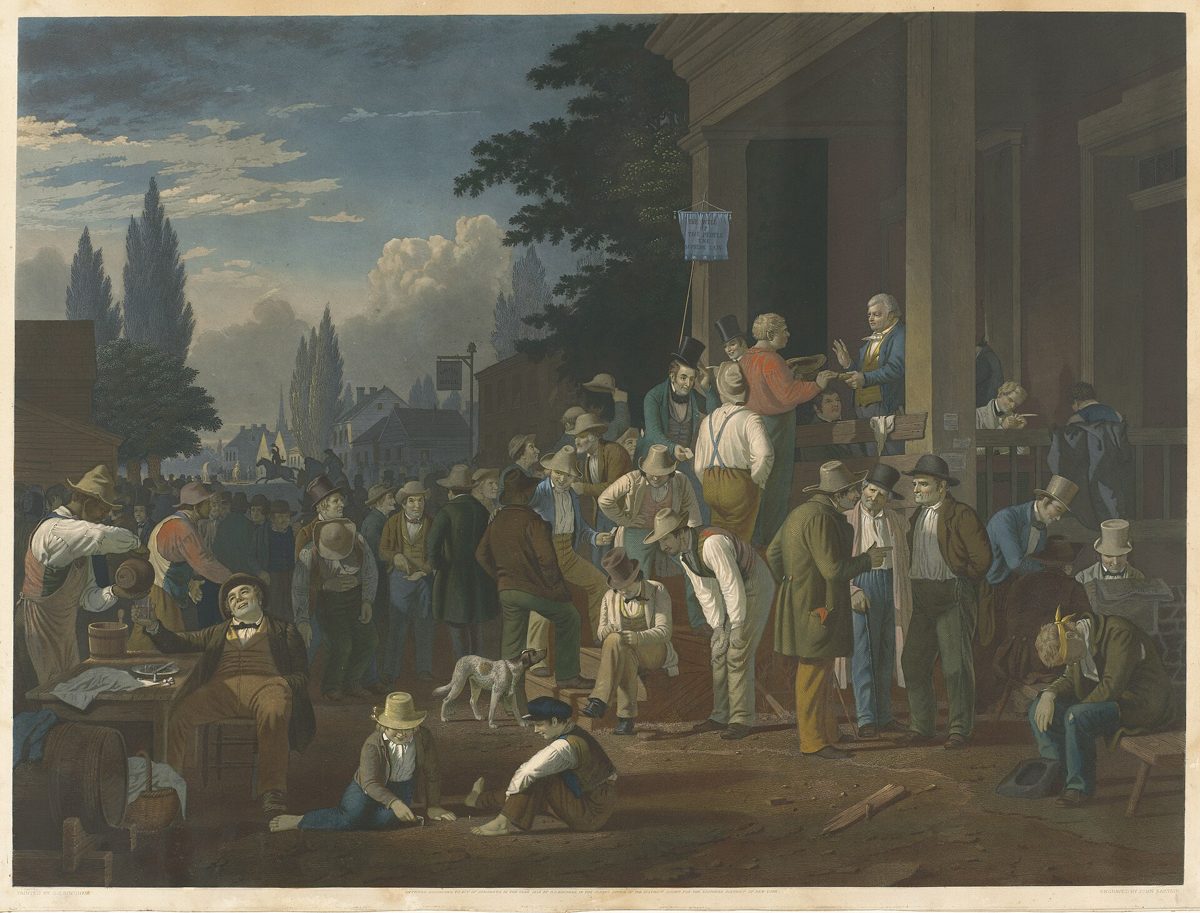
Picture labelling: The County Election (1854)
Look at the engraving after Bingham. Find:
- the man taking an oath
- the banner on the column
- the crowd
- a dog
Answer key
- at the top of the steps, a man raises his hand in front of an official
- The Will of the People the Supreme Law
- in front of the building: only men
- in the middle, near the voters
Tasks
- Read the diagram: where does the number 538 come from?
- Calculate: California has 52 representatives. How many electors does it have? Wyoming has 1 representative: how many electors?
- Say it: explain the diagram step by step with the passive and by: The president is elected by... The electoral votes are counted by... The new president is sworn in on...
Grammar on the board
To explain who chooses the president, we need the passive with by: The president is elected by the Electoral College. The votes are counted by Congress.
Listen to your teacher, then copy the board.
The passive voice (4): by + agent; prepositions by and with
- Rule
- by = who does the action.
The president is elected by the Electoral College. - Form
- The president is elected by the Electoral College. The votes are counted by Congress. The bill was signed by the president. No agent: Senators are elected for six years.
- Examples
- The president is elected by the Electoral College.
- The electoral votes are counted by Congress in early January.
- Watch out
- The president is elected from the electors. → by the electors.
- The ballots are counted by someone. → The ballots are counted (no useful agent).
- French and English
- par → by (agent); avec → with (tool). Le président est élu par les grands électeurs = The president is elected by the electors.
Quick check
- The president is elected ______ the Electoral College.
- The ballot is marked ______ a pen.
- Keep by? Senators are elected for six years by people.
Answer key
- by
- with
- No: Senators are elected for six years.
Practise
Stage 1. Recognise
Find the agent (after by). Write none if there is no agent.
- The president is elected by the Electoral College.
- Senators are elected for six years.
- The votes are counted by Congress.
- The ballots are counted in every state.
- The bill was signed by the president.
Answer key
- the Electoral College
- none
- Congress
- none
- the president
Stage 2. Transform
Rewrite in the passive. Keep by only when it is useful.
- The electors choose the president.
- Congress counts the electoral votes.
- The president signed the bill.
- People elect senators for six years.
- Someone counts the ballots in every state.
Answer key
- The president is chosen by the electors.
- The electoral votes are counted by Congress.
- The bill was signed by the president.
- Senators are elected for six years.
- The ballots are counted in every state.
Stage 3. Guided production
Explain the diagram step by step with the passive.
- the votes / cast / citizens / on Election Day
- all the electors of a state / give / to the winner
- the president / elect / the electors / in December
- the electoral votes / count / Congress / in early January
- the new president / swear in / on 20 January
Answer key
- The votes are cast by citizens on Election Day.
- All the electors of a state are given to the winner.
- The president is elected by the electors in December.
- The electoral votes are counted by Congress in early January.
- The new president is sworn in on 20 January.
A. Find the agent
Who does the action? Find the agent after by.
- The president is elected by the Electoral College.
- The votes are counted by Congress.
- The new president is usually sworn in by the Chief Justice.
Answer key
- the Electoral College
- Congress
- the Chief Justice
B. Active to passive with by
Rewrite in the passive. Keep the tense.
- The electors choose the president.
- Congress counts the electoral votes.
- The president signed the bill.
Answer key
- The president is chosen by the electors.
- The electoral votes are counted by Congress.
- The bill was signed by the president.
Figure of speech
Figures of speech: metonymy
Metonymy uses a place or an object to speak about the people linked to it. The White House announced means the president and his team. Capitol Hill means Congress. Washington often means the federal government.
- The White House said no. Who said no?
- Capitol Hill passed the law. Who passed it?
- Washington and Paris disagree. Who disagrees?
Answer key
- The president and his team.
- Congress.
- The American and the French governments.
Say it
Oral task: explain, your partner draws
Steps
- Hide the diagram.
- Explain it step by step.
- Your partner draws it.
- Compare with the real diagram.
- First, draw three boxes ...
- In the first box, write ...
- Then add ...
- Finally, write ...
Model answer
First, draw three boxes. In the first box, write 435 representatives. In the second, 100 senators. In the third, 3 for Washington, D.C. Then add them: 538. Finally, write 270 to win.
Gap-fill worksheet
- Election Day is on a in November.
- There are electors in total.
- A candidate needs electoral votes to win.
- Each state has a number of .
- The new president is sworn in on .
- A is when the votes are equal.
- The is the ceremony when the president starts the job.
- Each state sends a of its result to Congress.
- The vote is the vote of all the people.
- In 48 states, the system is .
Answer key
- Tuesday
- 538
- 270
- electors
- 20 January
- tie
- inauguration
- certificate
- popular
- winner-take-all
Going further (optional)
Modal passive: The result must be certified. Perfect passive: The votes have been counted. Modal perfect passive: The result could have been contested.
Translate into English
- Le président est élu par les grands électeurs.
- Les votes sont comptés par le Congrès début janvier.
Answer key
- The president is elected by the electors.
- The votes are counted by Congress in early January.