Session 3: The road to the White House: primaries and conventions
Recap check
- What are the two main parties?
- What are their symbols?
- How many times can a person be elected president?
Answer key
- The Democratic Party and the Republican Party.
- The donkey for the Democrats, the elephant for the Republicans.
- Twice (22nd Amendment).
What we need to say
Today you need to tell the story of past campaigns: what happened, and when.
Words to say it
| Word | Meaning | Example |
|---|---|---|
| a candidate | a person who wants to be elected | She is a candidate for president. |
| a primary | a vote to choose a party's candidate | Most states hold primaries. |
| a caucus | a party meeting to choose a candidate | Caucuses are meetings. |
| a convention | a big party meeting in summer | The convention chooses the candidate. |
Use the words
Who am I?. Read the riddle and find the word from the word grid.
- I am a vote to choose a party's candidate.
- I am a big party meeting in summer.
- I am the candidate for vice president.
- I am a discussion between candidates on TV.
- I am a person who wants to be elected.
Answer key
- a primary
- a convention
- a running mate
- a debate
- a candidate
More word practice
Put in order
To tell the steps of a campaign, put the eight steps in the right order.
- the electors vote
- primaries and caucuses
- Inauguration Day
- candidates announce
- TV debates
- national conventions
Answer key
- 6
- 2
- 8
- 1
- 4
- 3
Word partners
Match the verbs and the nouns to make phrases from the lesson.
- hold
- win
- choose
- take part in
- run
- launch
- a. a campaign
- b. a debate
- c. a running mate
- d. for president
- e. the nomination
- f. a primary
Answer key
- f (a primary)
- e (the nomination)
- c (a running mate)
- b (a debate)
- d (for president)
- a (a campaign)
Read, one sentence per line
- The campaign takes almost two years.
- Candidates announce that they want to run.
- To be president, you must be at least thirty-five years old, a citizen born American and a resident for at least fourteen years.
- From January to June of the election year, each party organises primaries (secret votes) or caucuses (party meetings) in every state to choose its candidate.
- The winners get delegates.
- In summer, from July to early September, each party holds a national convention: the delegates choose the candidate, who announces a running mate.
Look at the diagram
Timeline: the road to the White House
Source: USAGov, presidential election process.
Look at the drawing
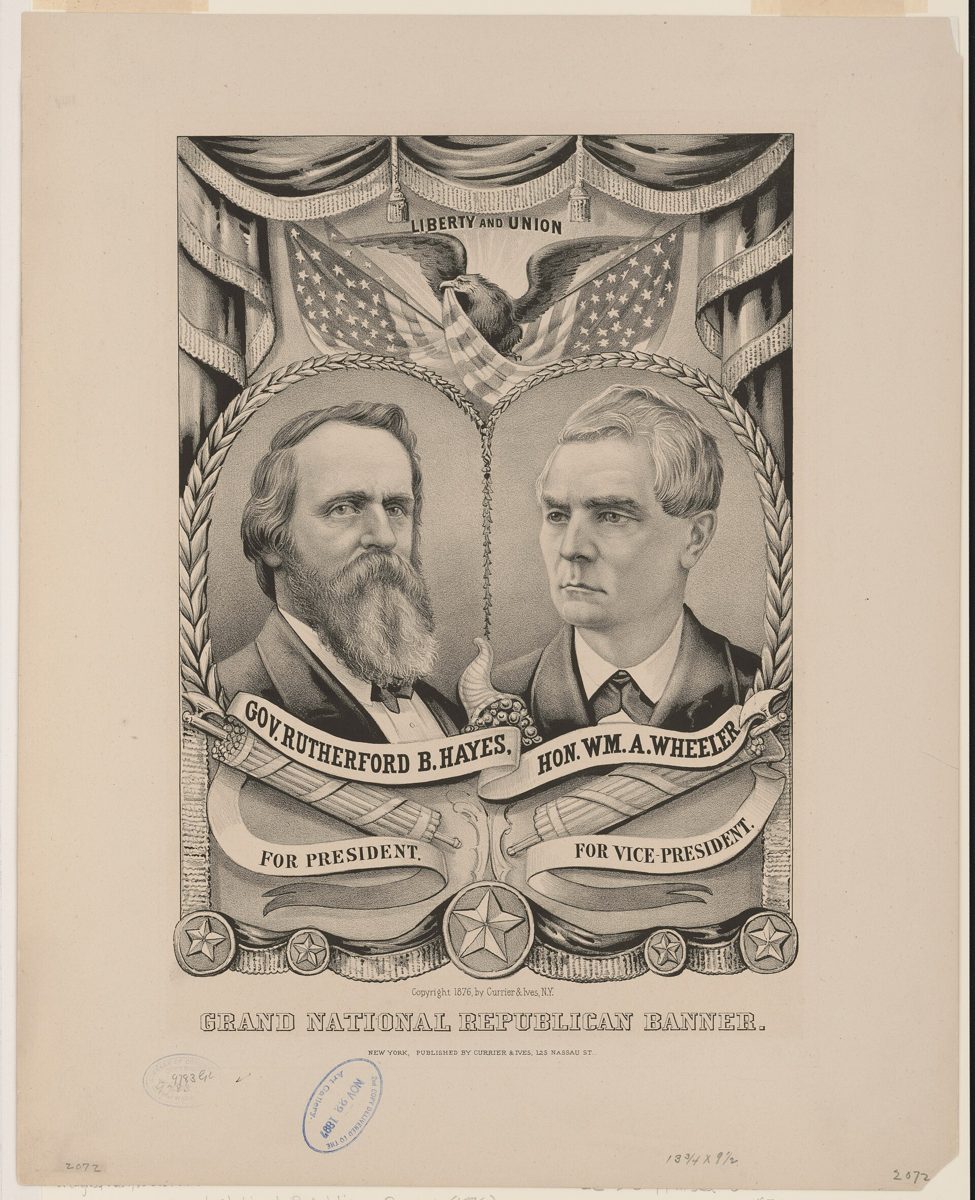
Picture labelling: the 1876 banner
Look at the Grand National Republican Banner. Find:
- the eagle
- the flags
- the words on the ribbon at the top
- the candidate for president
Answer key
- at the top, in the middle
- on both sides of the eagle
- Liberty and Union
- on the left: Rutherford B. Hayes, governor of Ohio
Tasks
- Read the timeline: what happens in spring? In summer? In November?
- Look at the 1860 convention: how many people can you see? Where are they? This convention chose Abraham Lincoln.
- Say it: tell the story of the 1860 convention and of the 1876 banner in two sentences each, with was or were + past participle.
Grammar on the board
To tell what happened in the past without naming who did it, we need the past passive: Abraham Lincoln was chosen in Chicago in 1860. The banners were printed in 1876.
Listen to your teacher, then copy the board.
The passive voice (3): the past; past simple and time prepositions
- Rule
- Past: was / were + past participle.
Lincoln was chosen in 1860. - Form
- Lincoln was chosen in 1860. The banners were printed in 1876. Question: Was Lincoln chosen in Chicago? Negative: Seward was not chosen.
- Examples
- Abraham Lincoln was chosen in Chicago in May 1860.
- The engraving was published by Harper's Weekly.
- Watch out
- Lincoln is chosen in 1860. → Lincoln was chosen in 1860 (finished date).
- The banners was printed. → The banners were printed.
- French and English
- French uses the passé composé: Lincoln a été choisi en 1860. English uses the past simple with a finished date: Lincoln was chosen in 1860, not has been chosen.
Quick check
- Lincoln ______ (choose) in 1860.
- The posters ______ (print) in 1876.
- ______ May 1860
Answer key
- was chosen
- were printed
- in
Practise
Stage 1. Recognise
Present passive (PR) or past passive (PA)?
- Lincoln was chosen in 1860.
- The candidate is chosen at the convention.
- The banners were printed in 1876.
- The debates are watched on TV.
- The Wigwam was built in Chicago.
Answer key
- PA
- PR
- PA
- PR
- PA
Stage 2. Transform
Rewrite in the past passive.
- The party chose Lincoln in 1860.
- They built the Wigwam in Chicago.
- The Republicans chose Hayes and Wheeler in 1876.
- The delegates nominated Lincoln.
- Harper's Weekly published the engraving in May 1860.
Answer key
- Lincoln was chosen by the party in 1860.
- The Wigwam was built in Chicago.
- Hayes and Wheeler were chosen by the Republicans in 1876.
- Lincoln was nominated by the delegates.
- The engraving was published by Harper's Weekly in May 1860.
Stage 3. Guided production
Build a past passive sentence with the words.
- the Wigwam / build / Chicago / 1860
- Abraham Lincoln / choose / the Republicans / May 1860
- the 1876 banner / print / for Hayes and Wheeler
- the first TV debates / watch / 1960
- the engraving / publish / Harper's Weekly
Answer key
- The Wigwam was built in Chicago in 1860.
- Abraham Lincoln was chosen by the Republicans in May 1860.
- The 1876 banner was printed for Hayes and Wheeler.
- The first TV debates were watched in 1960.
- The engraving was published by Harper's Weekly.
A. was or were?
Choose was or were.
- Lincoln ______ chosen in Chicago.
- The posters ______ printed in 1876.
- The convention ______ held in a big wooden hall.
- The debates ______ watched on TV.
Answer key
- was
- were
- was
- were
B. Present to past
Put the passive sentences in the past.
- The candidate is chosen at the convention.
- The running mate is announced in summer.
- The delegates are elected in the primaries.
Answer key
- The candidate was chosen at the convention.
- The running mate was announced in summer.
- The delegates were elected in the primaries.
Figure of speech
Figures of speech: the sports metaphor
American politics often speaks about elections as a race: this is a sports metaphor. A candidate runs for president, the leader is the front-runner, a surprise candidate is a dark horse. In 1860, William Seward was the front-runner, but the convention chose Abraham Lincoln.
- What does the race for the White House mean?
- What does to run for president mean?
- Who is the front-runner?
Answer key
- The competition to become president.
- To be a candidate.
- The candidate who is winning before the vote.
Say it
Oral task: the story of your banner (one minute)
Steps
- Show your banner.
- Say how your candidate was chosen.
- Give the slogan.
- Ask for votes.
- This is the banner of ...
- She was chosen by ...
- Our slogan is ...
- On Election Day, please vote for ...
Model answer
This is the banner of Sam Lee. She was chosen by the Green Party in March. Our slogan is Jobs for young people. On Election Day, please vote for Sam.
Gap-fill worksheet
- A candidate for president must be at least .
- In spring, parties hold and caucuses.
- In summer, the delegates meet at the .
- The candidate for vice president is the .
- In September and October, there are TV .
- A represents voters at the convention.
- The is the candidate chosen by the party.
- Yes we can was a famous .
- A includes posters, meetings and speeches.
- In 1860, Lincoln won the .
Answer key
- thirty-five
- primaries
- convention
- running mate
- debates
- delegate
- nominee
- slogan
- campaign
- nomination
Going further (optional)
Past perfect passive: had been + past participle, for an action before another past action: When the convention opened, the delegates had already been chosen. Informal passive: get + past participle: He got elected in 1860.
Translate into English
- Lincoln a été choisi à Chicago en 1860.
- La convention a eu lieu dans un immense bâtiment en bois.
Answer key
- Lincoln was chosen in Chicago in 1860.
- The convention was held in a huge wooden building.